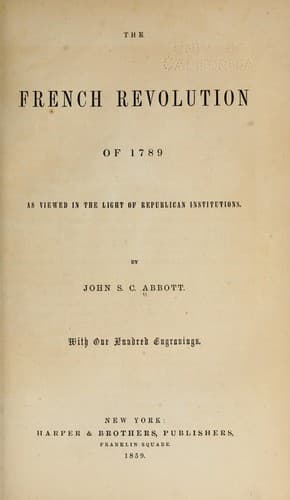
The French Revolution of 1789, as Viewed in the Light of Republican InstitutionsAbbott, John S. C. (John Stevens Cabot)
History
The French Revolution of 1789, as Viewed in the Light of Republican Institutions
Abbott, John S. C. (John Stevens Cabot)
France -- History -- Revolution, 1789-1799
"Despotism is what never entered into the head of the king. He never
had any wish but the happiness of his people, and this was the only
consideration that could be ever employed as a means of influencing
him. If any acts of authority were to be resorted to, he was never
to be persuaded but by showing him that some good was to be attained
or some evil avoided. I am convinced that his authority was never
considered by him, nor did he wish to maintain it but as the best means
of supporting and securing the tranquillity and peace of the community.
As we are now speaking of the causes that produced this regeneration of
the country, let us state the first to be the character of Louis XVI. A
king less of a good man and ministers more adroit, and we should have
had no revolution."
FOOTNOTES:
[Footnote 134: "The French Guards, those generous citizens, rebels
to their masters, in the language of despotism, but faithful to the
nation, are the first to swear never to turn their arms against
her."--_M. Rabaud de St. Etienne_, vol. i., p. 62.
Mr. Alison calls this the "_revolt and treason of the French Guards_."
The same occurrence assumes very different aspects as seen from
different stand-points.]
[Footnote 135: M. Rabaud de St. Etienne.]
[Footnote 136: Hist. Parlementaire, vol. ii., p. 32. Michelet, vol. i.,
p. 127.]
[Footnote 137: Histoire des Montagnards, par Alphonse Esquiros, p. 15.]
[Footnote 138: Thiers, vol. i., p. 61.]
[Footnote 139: "While on this subject I can not refrain from remarking
on the impolitic conduct of the nobles and the bishops. As they aimed
only to dissolve the Assembly, to throw discredit on its operations,
when the president stated a question they left the hall, inviting the
deputies of their party to follow them. With this senseless conduct
they combined an insulting disdain, both of the Assembly and of the
people who attended the sittings. Instead of listening, they laughed
and talked aloud, thus confirming the people in the unfavorable opinion
which it had conceived of them; and instead of striving to recover the
confidence and the esteem of the people, they strove only to gain their
hatred and contempt."--_Ferrières_, t. ii., p. 122.]
[Footnote 140: Histoire des Montagnards, par Alphonse Esquiros, p. 15.]
[Footnote 141: France and its Revolutions, by George Long, Esq.]
[Footnote 142: Some authorities say the 9th.]
[Footnote 143: France and its Revolutions, by George Long, Esq., vol.
i., p. 25.]
[Footnote 144: It is said that this famous address to the king was
composed by M. Dumont, the leading ideas having been communicated to
him by Mirabeau. A few extracts will give one an idea of the spirit of
the piece.
Public-domain text, read in full here on John Shaqi.
Reviews
Reviews
No reviews yet
Be the first to share your thoughts on this work.
Elsewhere in the archive
Join the Discussion
Join the discussion
Sign in to leave a comment or review.
Sign InorCreate an account