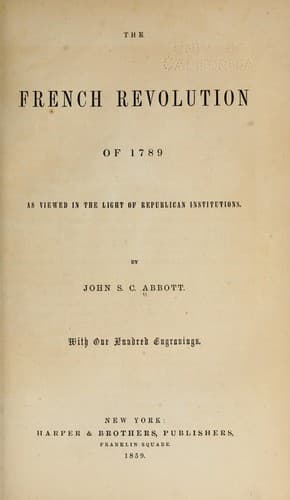
The French Revolution of 1789, as Viewed in the Light of Republican InstitutionsAbbott, John S. C. (John Stevens Cabot)
History
The French Revolution of 1789, as Viewed in the Light of Republican Institutions
Abbott, John S. C. (John Stevens Cabot)
France -- History -- Revolution, 1789-1799
"In the emotions of your own heart, sire, we look for the true safety
of the French. When troops advance from every quarter, when camps are
forming around us, when the capital is besieged, we ask one another
with astonishment, 'Hath the king distrusted the fidelity of his
people? What mean these menacing preparations? Where are the enemies of
the state and of the king that are to be subdued?'
"The danger, sire, is urgent, is universal, is beyond all the
calculations of human prudence.
"The danger is for the provinces. Should they once be alarmed for our
liberty we should no longer have it in our power to restrain their
impetuosity.
"The danger is for the capital. With what sensations will the people,
in their state of indigence, and tortured with the keenest anguish, see
the relics of its subsistence disputed for by a throng of threatening
soldiers?
"The danger is for the troops. They may forget that the ceremony of
enlisting made them soldiers, and recollect that nature made them men.
"The danger, sire, is yet more terrible. And judge of its extent by the
alarms which bring us before you. Mighty revolutions have arisen from
causes far less striking.
"Sire, we conjure you, in the name of our country, in the name of
your own happiness, and your own glory, to send back your soldiers to
the posts from which your counselors have drawn them. Send back that
artillery," etc.]
[Footnote 145: The Marquis of Ferrières acknowledges the insincerity of
the court in the king's answer. "The Assembly saw," he writes, "through
the snare that was spread for them. They would have lost all their
hold if they had once removed themselves from the security which the
vicinity of Paris afforded. Inclosed between the two camps (of Flanders
and Paris) they would have found themselves at the mercy of the
court."--_See also Hist. Phil. de la Rev. de France, par Ant. Fantin
Desodoards_, vol. i., p. 150.]
[Footnote 146: Madame de Staël's Considerations, etc., ch. xii.]
[Footnote 147: Alison, vol. i., p. 73.]
[Footnote 148: Miguet, vol. i., p. 50. Thiers, vol. i., p. 62.]
[Footnote 149: The following journal kept by the king during these
stormy days singularly illustrates the weakness of his character. We
give it as found in the interesting work, _Histoire des Montagnards,
par Alphonse Esquiros_.
Public-domain text, read in full here on John Shaqi.
Reviews
Reviews
No reviews yet
Be the first to share your thoughts on this work.
Elsewhere in the archive
Join the Discussion
Join the discussion
Sign in to leave a comment or review.
Sign InorCreate an account