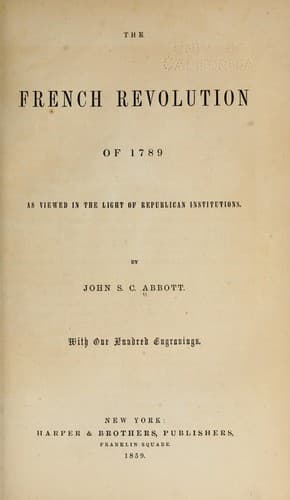
The French Revolution of 1789, as Viewed in the Light of Republican InstitutionsAbbott, John S. C. (John Stevens Cabot)
History
The French Revolution of 1789, as Viewed in the Light of Republican Institutions
Abbott, John S. C. (John Stevens Cabot)
France -- History -- Revolution, 1789-1799
It will be remembered that in the election of deputies to the
States-General Paris had been divided into sixty sections, each of
which chose two electors. These hundred and twenty electors, composed
of the most wealthy and influential citizens of Paris, immediately met
and passed the night deliberating respecting the anarchy into which the
city was so suddenly plunged. There were two foes whom the city had
now equally to dread--the court and the mob; the princes, bishops, and
nobles of the realm, with the armies and the resources of the kingdom,
on the one hand, and the starving multitude, infuriated by misery and
brutalized by ages of misrule, on the other. These were the two foes
against which the Revolution ever had to struggle. The mob triumphed
in the Reign of Terror. _Napoleon_ rescued the Revolution from their
bloody hands. The princes, with the aid of all the despotisms of
Europe, triumphed at Waterloo, and the Revolution was crushed _for a
time_.
Early on Monday morning, July 12th, the electors sent a deputation to
the National Assembly at Versailles soliciting the establishment of a
citizens' guard for the preservation of order. They gave a true and of
course a terrible description of the tumult prevailing in the city.[152]
The Assembly immediately sent a committee of twenty-four members to the
king, entreating him to withdraw the foreign troops from the capital.
But the queen and the court had now obtained such an ascendency over
the feeble-minded king that he was constrained to send a reply that he
should make no change whatever in his measures, and that the Assembly
could accomplish no useful purpose by interfering with matters in the
metropolis.
This was the day on which it was supposed armed bands were to march
to disperse the Assembly. It was publicly stated at Versailles that
a parliament composed of the nobles was to be suddenly organized at
Versailles, that all the deputies of the Third Estate were to be tried
for treason, that those members of the clergy and of the nobility
who had declared in their favor were to be consigned to perpetual
imprisonment, and that those who had been particularly active in the
cause of popular liberty were to be sent to the scaffold.[153]
In preparation for this event, the day before (Sunday, 12th), the
new ministry, bitterly hostile to the popular cause, had taken their
seats in the king's cabinet; Necker, a fugitive, was hastening into
the Netherlands; fifty thousand troops under Marshal Broglie, the most
determined advocate of aristocratic privilege, crowded the environs of
Paris and Versailles; and the troops on the 12th had been ordered to
those movements which were preliminary to the great event.[154]
Public-domain text, read in full here on John Shaqi.
Reviews
Reviews
No reviews yet
Be the first to share your thoughts on this work.
Elsewhere in the archive
Join the Discussion
Join the discussion
Sign in to leave a comment or review.
Sign InorCreate an account