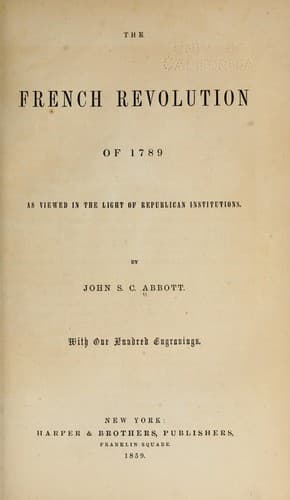
The French Revolution of 1789, as Viewed in the Light of Republican InstitutionsAbbott, John S. C. (John Stevens Cabot)
History
The French Revolution of 1789, as Viewed in the Light of Republican Institutions
Abbott, John S. C. (John Stevens Cabot)
France -- History -- Revolution, 1789-1799
Under such perilous circumstances the Assembly, with a heroism which
was truly sublime, determined, if they must perish, to perish in the
discharge of duty. No impartial man can read the record of these
days without paying the tribute of admiration to those men who thus
periled liberty and life in the cause of popular rights. "I have
studied history extensively," says De Tocqueville, "and I venture to
affirm that I know of no other revolution at whose outset so many men
were imbued with a patriotism as sincere, as disinterested, as truly
great."[155]
When the Assembly received the answer of the king refusing to withdraw
the troops, the only response it could make was in the passing of
resolutions. Unintimidated by menaces which might well appal the
stoutest heart, they resolved,
1. That M. Necker carried with him the regrets of the nation.
2. That it was the duty of the king immediately to remove the foreign
troops.
3. That the king's advisers, _of whatever rank_, were responsible for
present disorders.
4. That to declare the nation bankrupt was infamous.[156]
These were bold resolves. The third, it was well understood, referred
to the queen and to the two brothers of the king. The fourth branded
with infamy the measure which the court had already adopted in
virtually proclaiming bankruptcy and in making payments only in
paper.[157] After passing these resolutions the members of the Assembly
were in such peril that they deemed it best to keep together for mutual
protection. They voted their session permanent, and for seventy-two
hours, day and night, continued in their seats, one half deliberating
while the other half slept upon their benches. La Fayette, who was
one of the most resolute of this Spartan band, relieved the venerable
president in the labors of the chair.[158]
During the whole of Monday, even the king knew not what was passing
in Paris; and the Assembly, all communication being cut off between
Versailles and the metropolis, were in a state of most painful
suspense. Every moment they dreaded receiving the news that the city
was attacked, and the clangor of martial bands and arms around them led
them momentarily to expect the entrance of a military force for their
arrest. During the night of the 13th but little business was done, and
the wearied members remained talking in groups or dozing in their seats.
Tuesday morning, July 14th, dawned--ever-memorable day. The Assembly,
in the most perplexing anxiety, resumed its labors of preparing a
constitution. During the whole day no definite tidings could be
received from the city, and yet the booming of cannon was heard
proclaiming serious and sanguinary trouble. M. Dumont, who wrote under
the _nom de plume_ of Groenvelt,[159] thus describes the scene of which
he was an eye-witness:
Public-domain text, read in full here on John Shaqi.
Reviews
Reviews
No reviews yet
Be the first to share your thoughts on this work.
Elsewhere in the archive
Join the Discussion
Join the discussion
Sign in to leave a comment or review.
Sign InorCreate an account