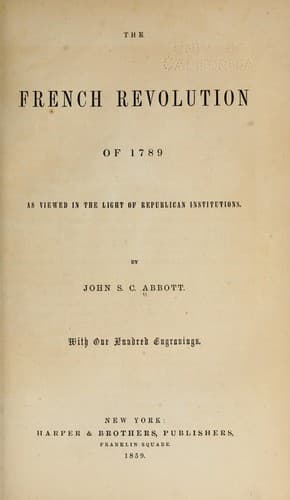
The French Revolution of 1789, as Viewed in the Light of Republican InstitutionsAbbott, John S. C. (John Stevens Cabot)
History
The French Revolution of 1789, as Viewed in the Light of Republican Institutions
Abbott, John S. C. (John Stevens Cabot)
France -- History -- Revolution, 1789-1799
Every thinking man saw clearly that matters were approaching a fearful
crisis. Marshal Broglie, proud and self-confident, was at Versailles
in constant conference with the court, and having at his command
fifty thousand men, abundantly armed and equipped, all of whom could
in a few hours be concentrated in the streets of Paris. Bensenval
had assembled his force of several thousand Swiss and German troops,
cavalry and artillery, in the Field of Mars. The enormous fortress of
the Bastille, with its walls forty feet thick at its base and ten at
the top, rising with its gloomy towers one hundred and twenty feet in
the air, with cannon, charged with grapeshot, already run out at every
embrasure to sweep the streets, commanded the city. It was garrisoned
by about eighty French soldiers; but, as it was feared that they
could not be wholly relied upon, forty Swiss troops were thrown in
as a re-enforcement who would be as blindly obedient as the muskets
they shouldered. Every moment rumors were reaching the city that
Marshal Broglie was approaching with all his troops. Still no arms or
ammunition could be obtained.
In this state of things a report was brought that a large quantity
of powder had been embarked in a boat from the Hôtel des Invalides,
and was floating down the Seine to be conveyed to Versailles. The
people immediately ran to the Electors, and obtained an order to have
the powder seized and brought to the hotel. It was promptly done. A
heroic clergyman, the Abbé Lefebvre, who had great influence over the
populace, assumed the perilous task of guarding the powder in one of
the lower rooms of the Hôtel de Ville and distributing it among the
people. For forty-eight hours this brave man guarded his dangerous
treasure in the midst of fire-arms and the surging of the multitude. A
drunken man at one time staggered in smoking amid the casks.[163]
Guns only were wanting now. It was well known that there were large
stores of them somewhere in the city, but no one knew where to find
them.
The mayor, Flesselles, who the people now began to suspect was deluding
them merely to gain time for the royal troops to enter the city, being
urged to point out the dépôt, said that the manufactory at Charleville
had promised to send him thirty thousand guns, and that twelve
thousand he was momentarily expecting. Soon a large number of boxes
were brought, marked "guns." The mayor ordered them to be stored in the
magazine till he should have time to distribute them. But the impatient
people so urged the electors that they broke open the boxes and found
them filled with rubbish. Was the mayor deceiving them? many anxiously
inquired. Flesselles, much embarrassed, sent the people to two
monasteries where he said guns were concealed; but the friars promptly
threw open the doors, and no arms were to be found.
Public-domain text, read in full here on John Shaqi.
Reviews
Reviews
No reviews yet
Be the first to share your thoughts on this work.
Elsewhere in the archive
Join the Discussion
Join the discussion
Sign in to leave a comment or review.
Sign InorCreate an account