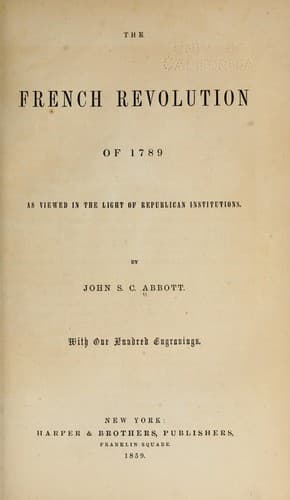
The French Revolution of 1789, as Viewed in the Light of Republican InstitutionsAbbott, John S. C. (John Stevens Cabot)
History
The French Revolution of 1789, as Viewed in the Light of Republican Institutions
Abbott, John S. C. (John Stevens Cabot)
France -- History -- Revolution, 1789-1799
The excitement at last became so intense, and the importunity so
pressing, that the electors referred the people to the mayor of the
city. Flesselles, the mayor, was an officer of the crown, but he
immediately obeyed the summons of the people, and came to the Hôtel de
Ville. Here he feigned to be entirely on their side, declared that he
was their father, and that he would preside over their meetings only by
the election of the people. This announcement was received with a burst
of enthusiasm. It was immediately decided that a citizen's guard should
be established.
Paris then contained nearly a million of inhabitants, and almost every
able-bodied man was eager to mount guard for the protection of the
city. There was no want of men, but as yet there was no efficient
organization, and there were no arms. The electors were very anxious
to avoid insurrection, and at first wished only for a guard simply
strong enough to protect the city. They therefore decreed that each
of the sixty districts should elect and arm two hundred of its most
respectable citizens. These twelve thousand men would constitute a
very admirable police, but a very poor army. Matters, however, were so
rapidly approaching a crisis, and the peril so fast increasing, that
on the afternoon of the same day it was decided that this citizen's
guard should consist of forty-eight thousand men, and that the colors
of the cockade should be blue and red. La Fayette proposed that they
should add white, the old color of France, saying, "I thus give you a
cockade which will go round the world."
The electors then appointed a committee to watch day and night over
the safety of the city. Thus a new and independent government, with
its strong army of defense, entirely detached from the throne, was
established in a day. It was the sudden growth of uncontrollable
events, which no human wisdom had planned. "But to whom," said the
mayor, Flesselles, "shall the oath of fidelity be taken?" "To the
Assembly of the citizens," an elector promptly replied.
Public-domain text, read in full here on John Shaqi.
Reviews
Reviews
No reviews yet
Be the first to share your thoughts on this work.
Elsewhere in the archive
Join the Discussion
Join the discussion
Sign in to leave a comment or review.
Sign InorCreate an account