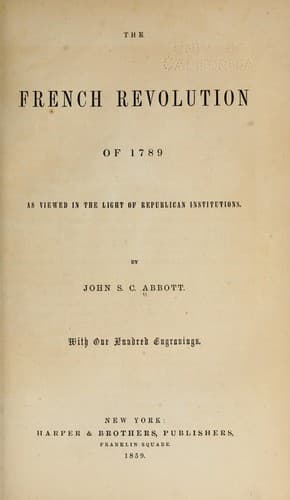
The French Revolution of 1789, as Viewed in the Light of Republican InstitutionsAbbott, John S. C. (John Stevens Cabot)
History
The French Revolution of 1789, as Viewed in the Light of Republican Institutions
Abbott, John S. C. (John Stevens Cabot)
France -- History -- Revolution, 1789-1799
The massive portals were thrown open, and the vast multitude, a living
deluge, plunging headlong, rushed in. They clambered the towers,
penetrated the cells, and descended into the dungeons and oubliettes.
Appalled they gazed upon the instruments of torture with which former
victims of oppression had been torn and broken. Excited as they were by
the strife, and exasperated by the shedding of blood, but one man in
the fortress, a Swiss soldier, fell a victim to their rage.
The victorious people now set out in a tumultuous procession to convey
their prisoners, the governor and the soldiers, to the Hôtel de Ville.
Those of the populace whose relatives had perished in the strife were
roused to fury, and called loudly for the blood of De Launey. Two very
powerful men placed themselves on each side of him for his protection.
But the clamor increased, the pressure became more resistless, and
just as they were entering the Place de Grève the protectors of the
governor were overpowered--he was struck down, his head severed by a
sabre stroke, and raised a bloody and ghastly trophy into the air upon
a pike.
In the midst of the great commotion two of the Swiss soldiers of
the Bastille, whom the populace supposed to have been active in the
cannonade, were seized, notwithstanding the most strenuous efforts to
save them, and hung to a lamp-post. A rumor passed through the crowd
that a letter had been found from the mayor, Flesselles, who was
already strongly suspected of treachery, directed to De Launey, in
which he said,
"I am amusing the Parisians with cockades and promises. Hold out till
the evening and you shall be relieved."[174]
Loud murmurs rose from the crowd which filled and surrounded the
hall. Some one proposed that Flesselles should be taken to the Palais
Royal to be tried by the people. The clamor was increasing and his
peril imminent. Pallid with fear he descended from the platform, and,
accompanied by a vast throng, set out for the Palais Royal. At the
turning of the first street an unknown man approached, and with a
pistol shot him dead. Infuriate wretches immediately cut off his head,
and it was borne upon a pike in savage triumph through the streets.
The French Guards, with the great body of the people, did what they
could to repress these bloody acts. The French and Swiss soldiers took
the oath of fidelity to the nation, and under the protection of the
French Guard were marched to places of safety where they were supplied
with lodgings and food. Thus terminated this eventful day. The fall of
the Bastille broke the right arm of the monarchy, paralyzed its nerves
of action, and struck it a death blow. The monarch of France, from his
palace at Versailles, heard the distant thunders of the cannonade, and
yet inscribed upon his puerile journal "_Nothing!_"[175]
FOOTNOTES:
Public-domain text, read in full here on John Shaqi.
Reviews
Reviews
No reviews yet
Be the first to share your thoughts on this work.
Elsewhere in the archive
Join the Discussion
Join the discussion
Sign in to leave a comment or review.
Sign InorCreate an account