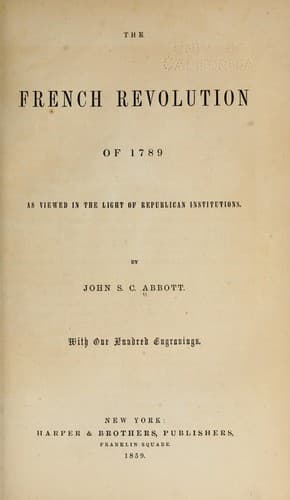
The French Revolution of 1789, as Viewed in the Light of Republican InstitutionsAbbott, John S. C. (John Stevens Cabot)
History
The French Revolution of 1789, as Viewed in the Light of Republican Institutions
Abbott, John S. C. (John Stevens Cabot)
France -- History -- Revolution, 1789-1799
[Footnote 152: "Thus Paris, without courts of justice, without
police, without a guard, at the mercy of one hundred thousand men
who were wandering idly in the middle of the night, and for the most
part wanting bread, believed itself on the point of being besieged
from without and pillaged from within; believed that twenty-five
thousand soldiers were posted around to blockade it and cut off all
supplies of provisions, and that it would be a prey to a starving
populace."--_Memoirs of Marmontel._]
[Footnote 153: Hist. Phil. de la Rev. Fr., par Ant. Fantin Desodoards,
t. i., p. 148.]
[Footnote 154: Professor William Smyth, in his very able and candid
lectures, delivered at the University of Cambridge, England, though his
sympathies are with the court in this conflict, writes:
"On the whole, it appears to me that there can be no doubt that a
great design had been formed by the court for the dissolution of the
National Assembly and the assertion of the power of the crown. That
military force was to have been produced, and according to the measure
of its success would, in all probability, have been the depression
of the spirit of liberty, even of national liberty, then existing in
France. Less than this can not well be supposed; much more may be
believed."--_Lectures on the French Revolution_, vol. i., p. 251.]
[Footnote 155: The Old Régime and the Revolution, by M. de Tocqueville,
p. 190.]
[Footnote 156: Michelet, vol. i., p. 136.]
[Footnote 157: "They were going to make payments with a paper money,
without any other guarantee than the signature of an insolvent
king."--_Michelet_, vol. i., p. 137.]
[Footnote 158: "A list of the proscribed had been drawn up in the
committee of the queen. Sixty-nine deputies, at the head of whom
were placed Mirabeau, Sièyes, and Bailly, were to be imprisoned
in the citadel of Metz, and from thence led to the scaffold, as
guilty of rebellion. The signal agreed upon for this St. Bartholomew
of the representatives of the people was the change of the
ministry."--_Histoire des Montagnards, par Alphonse Esquiros_, p. 15.]
[Footnote 159: Lectures on the French Revolution, by Wm. Smyth, vol.
i., p. 241.]
[Footnote 160: Louis, Viscount of Noailles, was a deputy of the nobles.
With La Fayette, Rochefoucault, and others he warmly espoused the cause
of popular liberty. He voted in favor of uniting with the National
Assembly, and was the first to exhort the clergy and the nobility to
renounce their privileges, as injurious to the common weal. When the
Revolution sank degraded into the hands of low and worthless men, he
retired from the public service; but when Napoleon came to the rescue,
he again entered the army, and was subsequently killed in a battle with
the English.--_Enc. Am., Art. Noailles._]
Public-domain text, read in full here on John Shaqi.
Reviews
Reviews
No reviews yet
Be the first to share your thoughts on this work.
Elsewhere in the archive
Join the Discussion
Join the discussion
Sign in to leave a comment or review.
Sign InorCreate an account