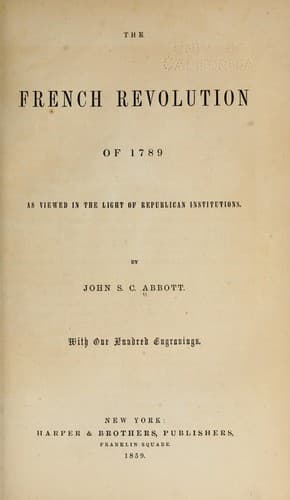
The French Revolution of 1789, as Viewed in the Light of Republican InstitutionsAbbott, John S. C. (John Stevens Cabot)
History
The French Revolution of 1789, as Viewed in the Light of Republican Institutions
Abbott, John S. C. (John Stevens Cabot)
France -- History -- Revolution, 1789-1799
[Footnote 161: "The better part of the Assembly," writes Ferrières,
"strangers to all the intrigues which might be going forward, was
filled with alarm at the sad reports that were circulating, and
terrified at the designs of the court, which they were assured went to
the seizing of Paris, the dissolution of the Assembly, and the massacre
of the citizens. In the mean time the partisans of the court concealed
their joy under an appearance of indifference. They came to the
sittings to see what turns the deliberations would take, to enjoy their
triumph, and the humiliation of the Assembly. The Assembly they looked
upon as annihilated."]
[Footnote 162: Michelet, vol. i., p. 38; Geo. Long, Esq., vol. i., p.
28.]
[Footnote 163: "This heroic man was the Abbé Lefebvre d'Ormesson.
No man rendered a greater service to the Revolution and the city of
Paris."--_Michelet_, vol. i., p. 140.
"A patriot, in liquor, insisted on sitting to smoke on the edge of
one of the powder-barrels. There smoked he, independent of the world,
till the Abbé purchased his pipe for three francs, and pitched it
far."--_Carlyle_, vol. i., p. 191.]
[Footnote 164: Louis Blanc, Histoire de la Revolution Française, vol.
ii., p. 365.]
[Footnote 165: Michelet, vol. i., p. 156.]
[Footnote 166: Histoire des Montagnards, par Alphonse Esquiros, p. 16.]
[Footnote 167: M. Rabaud de St. Etienne, vol. i., p. 66.]
[Footnote 168: "Its walls, ten feet thick at the top of its towers,
and thirty or forty at the base, might long laugh at cannon-balls. Its
batteries, firing down upon Paris, could in the mean time demolish the
whole of the Marais and the Faubourg St. Antoine. Its towers pierced
with windows and loop-holes, protected by double and triple gratings,
enabled the garrison in full security to make a dreadful carnage of its
assailants."--_Michelet_, vol. i., p. 143.]
[Footnote 169: Thiers, vol. i., p. 69.]
[Footnote 170: "Old men," says Michelet, "who have had the happiness
and the misery to see all that has happened in this unprecedented half
century, declared that the grand and national achievements of the
Republic and the Empire had, nevertheless, a partial non-unanimous
character. But that the 14th of July alone was the day of the whole
people."--_Michelet_, vol. i., p. 144.]
[Footnote 171: Histoire Des Montagnards par Alphonse Esquiros, p. 17.]
[Footnote 172: Michelet, vol. i., p. 156.]
[Footnote 173: "Properly speaking the Bastille was not taken, it
surrendered. Troubled by a bad conscience, it went mad, and lost all
presence of mind."--_Michelet_, vol. i., p. 156.]
CHAPTER XIV.
THE KING RECOGNIZES THE NATIONAL ASSEMBLY.
Public-domain text, read in full here on John Shaqi.
Reviews
Reviews
No reviews yet
Be the first to share your thoughts on this work.
Elsewhere in the archive
Join the Discussion
Join the discussion
Sign in to leave a comment or review.
Sign InorCreate an account