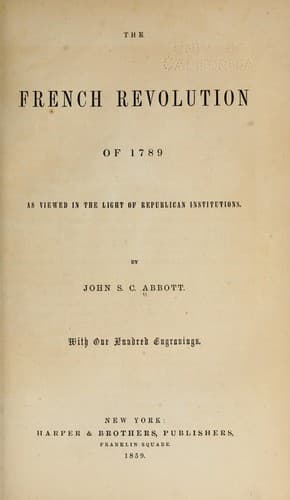
The French Revolution of 1789, as Viewed in the Light of Republican InstitutionsAbbott, John S. C. (John Stevens Cabot)
History
The French Revolution of 1789, as Viewed in the Light of Republican Institutions
Abbott, John S. C. (John Stevens Cabot)
France -- History -- Revolution, 1789-1799
The masses, enraged by the insults and aggressions of the privileged
classes, still appreciated the kindly nature of the king, and spoke of
him with respect and even affection. Efforts were made by the court to
conceal from Louis the desperate state of affairs, and at his usual
hour of eleven o'clock he retired to his bed, by no means conscious
that the sceptre of power had passed from his hands.
The Duke of Liancourt, whose office as grand master of the wardrobe,
allowed him to enter the chamber of the king at any hour, was a sincere
friend of Louis. He could not see him rush thus blindly to destruction,
and, accordingly, entering his chamber and sitting down by his bedside,
he gave him a truthful narrative of events in Paris. The king,
astonished and alarmed, exclaimed, "Why, it is a revolt!" "Nay, sire,"
replied Liancourt, "it is a revolution!"
The king immediately resolved that he would the next morning,
without any ceremony, visit the National Assembly, and attempt a
reconciliation. The leading members of the court, now fully conscious
of their peril, were assembled in the saloons of the Duchess of
Polignac, some already suggested flight from the realm to implore the
aid of foreign kings. The Assembly was still, during these midnight
hours, deliberating in great anxiety. Many of the members, utterly
exhausted by their uninterrupted service by day and by night, were
slumbering upon the benches. It was known by all that this was the
night assigned for the great assault; and a rumor was passing upon all
lips that the hall of the Assembly had been undermined that all the
deputies might be blown into the air.
Paris at this hour presented a scene of awful tumult. It was
momentarily expected that the royal troops would arrive with cavalry
and artillery, and that from the heights of Montmartre bomb-shells
would be rained down upon the devoted city. Men, women, and children
were preparing for defense. The Bastille was guarded and garrisoned.
The pavements were torn up, barricades erected, and ditches dug. The
windows were illuminated to throw the light of day into the streets.
Paving stones and heavy articles of furniture were conveyed to the
roofs of the houses to be thrown down upon the assailing columns. Every
smith was employed forging pikes, and thousands of hands were busy
casting bullets. Tumultuous throngs of characterless and desperate
men swept through the streets, rioting in the general anarchy. The
watch-words established by the citizen patrols were "Washington and
Liberty." Thus passed the night of the 14th of July in the Chateau of
Versailles, in the hall of the Assembly, and in the streets of Paris.
Public-domain text, read in full here on John Shaqi.
Reviews
Reviews
No reviews yet
Be the first to share your thoughts on this work.
Elsewhere in the archive
Join the Discussion
Join the discussion
Sign in to leave a comment or review.
Sign InorCreate an account