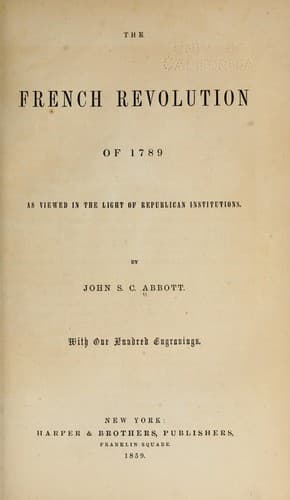
The French Revolution of 1789, as Viewed in the Light of Republican InstitutionsAbbott, John S. C. (John Stevens Cabot)
History
The French Revolution of 1789, as Viewed in the Light of Republican Institutions
Abbott, John S. C. (John Stevens Cabot)
France -- History -- Revolution, 1789-1799
At two o'clock in the morning of the 15th the Assembly ceased its
deliberations for a few hours, and the members, though the session
was still continued, sought such repose as they could obtain in their
seats. At eight o'clock the discussions were resumed. It was resolved
to send a deputation of twenty-four members, again to implore the king
to respect the rights of the people, and no longer to suffer them to
be goaded to madness by insults and oppression. As the deputation was
about to leave, Mirabeau rose and said, "Tell the king that the foreign
hordes surrounding us received yesterday the caresses, encouragement,
and bribes of the court; that all night long these foreign satellites,
gorged with money and wine, in their impious songs have predicted the
enslavement of France, and have invoked the destruction of the National
Assembly; tell him that in his very palace the courtiers have mingled
dancing with these impious songs, and that such was the prelude to the
massacre of St. Bartholomew."
He had hardly uttered these words ere the Duke of Liancourt entered and
announced that the king was coming in person to visit the Assembly. The
doors were thrown open, and, to the astonishment of the Assembly, the
king, without guard or escort and accompanied only by his two brothers,
entered. A shout of applause greeted him. In a short and touching
speech the king won to himself the hearts of all. He assured them of
his confidence in the Assembly; that he had never contemplated its
violent dissolution; and that he sincerely desired to unite with the
Assembly in consulting for the best interests of the nation. He also
declared that he had issued orders for the withdrawal of the troops
both from Paris and Versailles, and that, hereafter, the counsels of
the National Assembly should be the guide of his administration.[177]
This conciliatory speech was received by the mass of the deputies with
rapturous applause. The aristocratic party were, however, greatly
chagrined, and, retiring by themselves, with whispers and frowns gave
vent to their vexation; but the general applause drowned the feeble
murmurs of the nobles. Nearly the whole Assembly rose in honor of the
king as he left, and, surrounding him in tumultuous joy, they escorted
him back to his palace. A vast crowd from Paris and Versailles thronged
the streets, filling the air with their loyal and congratulatory
shouts. The queen, who was sitting anxiously in her boudoir, heard the
uproar and was greatly terrified. Soon it was announced to her that
the king was returning in triumph: she stepped out upon a balcony and
looked down upon the broad avenue filled with a countless multitude.
The king was on foot; the deputies encircled him, interlacing their
arms to protect him from the crowd, which was surging tumultuously
around with every manifestation of attachment and joy.
Public-domain text, read in full here on John Shaqi.
Reviews
Reviews
No reviews yet
Be the first to share your thoughts on this work.
Elsewhere in the archive
Join the Discussion
Join the discussion
Sign in to leave a comment or review.
Sign InorCreate an account