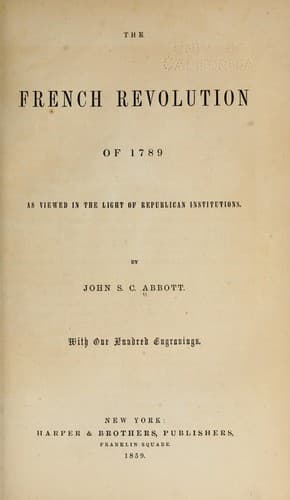
The French Revolution of 1789, as Viewed in the Light of Republican InstitutionsAbbott, John S. C. (John Stevens Cabot)
History
The French Revolution of 1789, as Viewed in the Light of Republican Institutions
Abbott, John S. C. (John Stevens Cabot)
France -- History -- Revolution, 1789-1799
The new government was now established, consolidated with power which
neither the court nor the people as yet even faintly realized. The
National Assembly and the municipality of Paris were now supreme. A
million of men were ready to draw the sword and spring into the ranks
to enforce their decrees. The king was henceforth but a constitutional
monarch; though by no means conscious of it, his despotic power had
passed away, never to be regained. The Revolution had now made such
strides that nothing remained but to carry out those plans which
might be deemed essential for the welfare of France. The Revolution
thus far had been almost bloodless. And had it not been for the
interference of surrounding despots, who combined their armies to
rivet anew the chains of feudal aristocracy upon the French people,
the subsequent horrors of the Revolution, in all probability, never
would have occurred. Men of wisdom and of the purest patriotism were at
the head of these popular movements. Every step which had been taken
had been wisely taken. The object which all sought was _reform_, not
_revolution_--the reign of a constitutional monarchy, like that of
England, not the reign of terror.
A republic was not then even thought of. A monarchy was in accordance
with the habits and tastes of the people, and would leave them still in
sympathy with the great family of governments which surrounded them.
La Fayette, Talleyrand, Sièyes, Mirabeau, Bailly, and all the other
leaders in this great movement, wished only to infuse the spirit of
personal liberty into the monarchy of France.
But when all the surrounding despotisms combined and put their armies
in motion to invade France, determined that the French people should
not be free, and when the aristocracy of France combined with these
foreign invaders to enslave anew these millions who had just broken
their chains, a spirit of desperation was roused which led to all the
woes which ensued. We can not tell what would have been the result had
there not been the combination of these foreign kings, but we _do_
know that the results which _did_ ensue were the direct and legitimate
consequence of that combination.
It will be remembered that the French Guards, espousing the popular
side, had refused to fire upon the people. This disobedience to
the royal officers was, of course, an act of treason. The Duke of
Liancourt, speaking in behalf of the king, said, "The king _pardons_
the French Guards." At the utterance of the obnoxious word _pardon_, a
murmur of displeasure ran through the hall. Some of the guards who were
present immediately advanced to the platform, and one, as the organ of
the rest, said, firmly and nobly,
"We can not accept a _pardon_. We need none. In serving the nation we
serve the king; and the scenes now transpiring prove it."
Public-domain text, read in full here on John Shaqi.
Reviews
Reviews
No reviews yet
Be the first to share your thoughts on this work.
Elsewhere in the archive
Join the Discussion
Join the discussion
Sign in to leave a comment or review.
Sign InorCreate an account