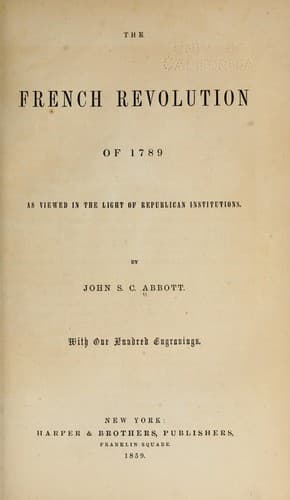
The French Revolution of 1789, as Viewed in the Light of Republican InstitutionsAbbott, John S. C. (John Stevens Cabot)
History
The French Revolution of 1789, as Viewed in the Light of Republican Institutions
Abbott, John S. C. (John Stevens Cabot)
France -- History -- Revolution, 1789-1799
The laconic speech was greeted with thunders of applause, and nothing
more was said about a pardon. The lower clergy, who were active in
these movements, were not unmindful of their obligations to God. The
whole people seemed to sympathize in this religious sentiment. At the
suggestion of the Archbishop of Paris a Te Deum was promptly voted, and
the electors, deputies, and new magistrates, accompanied by an immense
concourse of citizens, and escorted by the French Guards, repaired to
the Cathedral of Nôtre Dame, where the solemn chant of thanksgiving was
devoutly offered. La Fayette and Bailly then took the oath of office.
Upon the return of the deputation to the Assembly at Versailles, Lally
Tollendal reported that the universal cry of the Parisians was for the
recall of Necker, with which minister the popular cause was held to be
identified. A motion was immediately introduced to send a deputation
to the king soliciting his recall. They had but just entered upon the
discussion of this question when a message was received from Louis
announcing the dismissal of the obnoxious ministers, accompanied by an
unsealed letter addressed to Necker, summoning him to return to his
post. Inspired by gratitude for this act, the Assembly immediately
addressed a vote of thanks to the king.
The populace of Paris had expressed the earnest wish that the king
would pay them a visit. During the afternoon and evening of the 16th,
the question was earnestly discussed by the court at Versailles,
whether the king should fly from the kingdom, protected by the foreign
troops whom he could gather around him, and seek the assistance of
foreign powers, or whether he should continue to express acquiescence
in the popular movement and visit the people in Paris. The queen was in
favor of escape. She told Madame Campan that, after a long discussion
at which she was present, the king, impatient and weary, said, "Well,
gentlemen, we must decide. Must I go away, or stay? I am ready to do
either." "The majority," the queen continued, "were for the king's
stay. Time will show whether the right choice has been made."[180]
The king was very apprehensive that in going powerless to Paris he
might be assassinated. In preparation of the event, he partook of the
sacrament of the Lord's Supper, and nominated his brother, subsequently
Louis XVIII., Lieutenant of France, in case of his detention or death.
Early the next morning, the 17th of July, he took an affecting leave of
his weeping, distracted family, to visit the tumultuous metropolis. His
pale and melancholy countenance impressed every observer. The queen,
who was bitterly hostile to the movement, was almost in despair. She
immediately retired to her chamber, and employed herself in writing an
address to the Assembly, which she determined to present in person in
case the king should be detained a prisoner.[181]
Public-domain text, read in full here on John Shaqi.
Reviews
Reviews
No reviews yet
Be the first to share your thoughts on this work.
Elsewhere in the archive
Join the Discussion
Join the discussion
Sign in to leave a comment or review.
Sign InorCreate an account