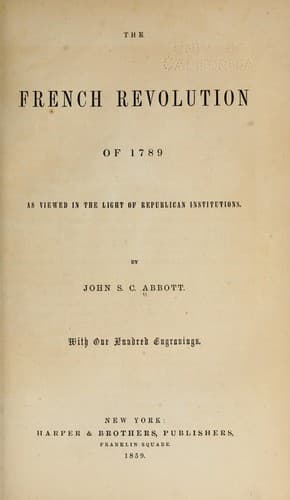
The French Revolution of 1789, as Viewed in the Light of Republican InstitutionsAbbott, John S. C. (John Stevens Cabot)
History
The French Revolution of 1789, as Viewed in the Light of Republican Institutions
Abbott, John S. C. (John Stevens Cabot)
France -- History -- Revolution, 1789-1799
The miserable wretch was dragged up the steps of the Hôtel de Ville.
But the mob was now in the ascendency. There was no longer law or
even semblance of authority. An attempt was made by the National
Guard to convey him to the Abbaye; but the moment they appeared with
their prisoner in the street the crowd fell irresistibly upon him.
Seizing a gun, he fought like a tiger; but he soon fell, pierced
with bayonets.[195] A dragoon tore out his heart, and carried it
dripping with blood to the Hôtel de Ville, saying, "Here is the heart
of Berthier!"[196] The man attempted an extenuation of his ferocity
by declaring that Berthier had caused the death of his father. His
comrades, however, deemed such brutality a disgrace to their corps.
They told him that he must die, and that they would all fight him in
turn until he was killed. He was killed that night.[197]
These deeds of violence excited the disgust of Bailly, the mayor, and
La Fayette. Having such evidence that both the municipality and the
National Guard were impotent, both La Fayette and Bailly tendered their
resignations.
They were, however, prevailed upon to continue in office by the most
earnest solicitations of the friends of France.[198]
A report was spread throughout the kingdom that the fugitive princes
and nobles were organizing a force on the frontiers for the invasion of
France, that the armies of foreign despots were at their command, and
that all the Royalists in France were conspiring to welcome them. The
panic which pervaded the kingdom was fearful. France, just beginning
to breathe the atmosphere of liberty, was threatened with chains of
slavery more heavy than had ever been worn before. The energies of a
semi-enfranchised people were roused to the utmost vigor. Every city,
and every village of any importance, organized a municipal government
in sympathy with the municipality in Paris. The peasantry in the rural
districts, hating the nobles who had long oppressed them, attacked
and burned their castles. There was a universal rising of the Third
Estate against the tyranny of the privileged classes, assailing that
tyranny with the only instrument at its command--blind brutal force.
In one week three millions of men assumed the military character, and
organized themselves for the defense of the kingdom. The tricolored
cockade became the national uniform.
The National Assembly, intently occupied in framing a constitution, was
greatly disturbed by reports of these wide-spread acts of violence;
yet daily delegations arrived with vows of homage from the different
provinces, and with their recognition of the authority of the national
representatives.
Public-domain text, read in full here on John Shaqi.
Reviews
Reviews
No reviews yet
Be the first to share your thoughts on this work.
Elsewhere in the archive
Join the Discussion
Join the discussion
Sign in to leave a comment or review.
Sign InorCreate an account