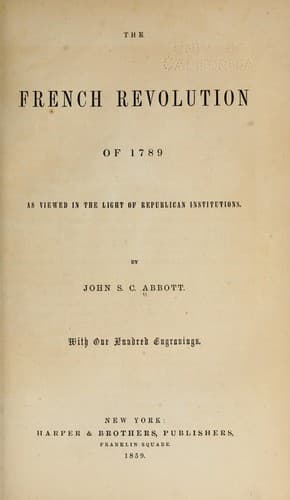
The French Revolution of 1789, as Viewed in the Light of Republican InstitutionsAbbott, John S. C. (John Stevens Cabot)
History
The French Revolution of 1789, as Viewed in the Light of Republican Institutions
Abbott, John S. C. (John Stevens Cabot)
France -- History -- Revolution, 1789-1799
Necker was in exile at Basle. He had left the Polignacs in pride and
power at Versailles; _they_ now were fugitives. One morning one of
the Polignacs hastened to Necker's apartment and informed him of the
overthrow of the court and the triumph of the people. Necker had just
received these tidings when a courier placed in his hand the letter
of the king recalling him to the ministry. The grandest of triumphs
greeted him from the moment his carriage entered France until he was
received with a delirium of joy in the streets of Paris. The people,
who had with lawless violence punished Foulon and Berthier, who had
conspired so inhumanly for the overthrow of their liberties, were
determined that others, who with equal malignity had conspired against
them, should also be condemned. Necker humanely resolved that an act of
general amnesty should be passed. Many of his friends assured him that
it was not safe to attempt to secure the passage of such a measure;
that the crimes of the leaders of the court were too great to be thus
easily forgotten; that the indignant nation, finding Necker pleading
the cause of the court, would think that he had been bought over; and
that thus he would only secure his own ruin. But Necker, relying upon
his popularity, resolved to make the trial. On the 29th of July he
repaired to the Hôtel de Ville. As he passed through the streets and
entered the spacious hall, he was received with rapturous applause.
Deeming his popularity equal to the emergence, he demanded a general
amnesty. In the enthusiasm of the moment it was granted by acclamation.
Necker retired to his apartments delighted with his success; but before
the sun had set he found himself cruelly deceived. The Assembly, led by
Mirabeau, remonstrated peremptorily against this usurpation of power by
the Municipality of Paris, asserting that that body had no authority
either to condemn or to pardon. The measure of amnesty was annulled by
the Assembly, and the detention of the prisoners confirmed.
The great question which now agitated the Assembly was, what measures
were to be adopted to bring order out of the chaos into which France
was plunged. All the old courts were virtually annihilated. No new
courts had been organized with the sanction of national authority. The
nobles and all their friends, in conference with the emigrants and
foreign despots, were conspiring to reinstate the reign of despotic
power. The people were in a state of terror. The degraded, the
desperate, the vicious, in banditti hordes, were sweeping the country,
burning and pillaging indiscriminately. It was proposed to publish a
decree enjoining upon the people to demean themselves peaceably, to
pay such taxes and duties as were not yet suppressed, and to yield
obedience for the present to the old laws of the realm, obnoxious and
unjust as they undeniably were.
Public-domain text, read in full here on John Shaqi.
Reviews
Reviews
No reviews yet
Be the first to share your thoughts on this work.
Elsewhere in the archive
Join the Discussion
Join the discussion
Sign in to leave a comment or review.
Sign InorCreate an account