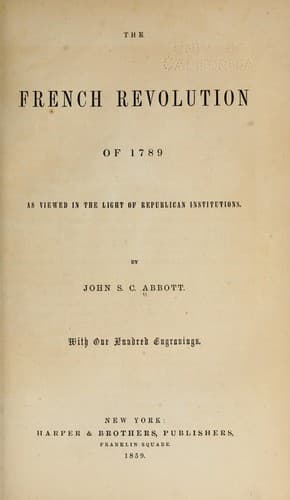
The French Revolution of 1789, as Viewed in the Light of Republican InstitutionsAbbott, John S. C. (John Stevens Cabot)
History
The French Revolution of 1789, as Viewed in the Light of Republican Institutions
Abbott, John S. C. (John Stevens Cabot)
France -- History -- Revolution, 1789-1799
While this question was under discussion, the Viscount de Noailles
and the Duke d'Aguillon, both distinguished members of the nobility,
ascended the tribune and declared that it was vain to attempt to
quiet the people by force, that the only way of appeasing them was
by removing the cause of their sufferings. They then, though both of
them members of the privileged class, nobly avowed the enormity of the
aggressions under which, by the name of feudal rights, the people were
oppressed, and voted for the repeal of those atrocities.
It is a remarkable fact that in this great revolution the boldest
and ablest friends of popular rights came out from the body of the
nobles themselves. Some were influenced by as pure motives as can move
the human heart. With others, perhaps, selfish and ambitious motives
predominated. Among the most active in all these movements, we see La
Fayette, Talleyrand, Sièyes, Mirabeau, and the Duke of Orleans. But
for the aid of these men, whatever may have been the motives which
influenced the one or the other, the popular cause could not have
triumphed. And now we find, in the National Assembly, two of the most
distinguished of the nobles rising and themselves proposing the utter
abolition of all feudal rights.
It was the 4th of August, 1789, when this memorable scene was enacted
in the National Assembly, one of the most remarkable which ever
transpired on earth. The whole body of the nobles seems to have been
seized with a paroxysm of magnanimity and disinterestedness. One
of the deputies of the _Tiers Etat_, M. Kerengal, in the dress of
a farmer, gave a frightful picture of the sufferings of the people
under feudal oppression.[199] There was no more discussion. No voice
defended feudality. The nobles, one after another, renounced all their
prerogatives. The clergy surrendered their tithes. The deputies of the
towns and of the provinces gave up their special privileges, and, in
one short night, all those customs and laws by which, for ages, one man
had been robbed to enrich another were scattered to the winds. Equality
of rights was established between all individuals and all parts of
the French territory. Louis XVI. was then proclaimed the restorer of
French liberty. It was decreed that a medal should be struck off in
his honor, in memory of that glorious night. And when the Archbishop
of Paris proposed that God's goodness should be acknowledged in a
solemn Te Deum, to be celebrated in the king's chapel, in the presence
of the king and of all the members of the National Assembly, it was
carried by acclamation. During the whole of this exciting scene, when
sacrifices were made such as earth never witnessed before; when nobles
surrendered their titles, their pensions, and their incomes; when towns
and corporations surrendered their privileges and pecuniary immunities;
when prelates relinquished their tithes and their benefices; not a
solitary voice of opposition or remonstrance was heard. The whole
Public-domain text, read in full here on John Shaqi.
Reviews
Reviews
No reviews yet
Be the first to share your thoughts on this work.
Elsewhere in the archive
Join the Discussion
Join the discussion
Sign in to leave a comment or review.
Sign InorCreate an account