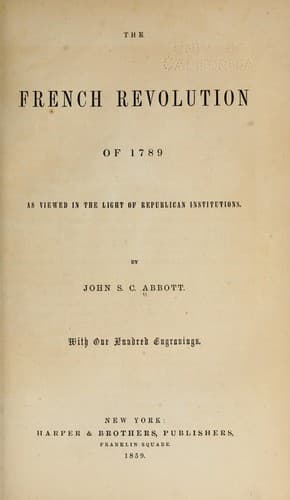
The French Revolution of 1789, as Viewed in the Light of Republican InstitutionsAbbott, John S. C. (John Stevens Cabot)
History
The French Revolution of 1789, as Viewed in the Light of Republican Institutions
Abbott, John S. C. (John Stevens Cabot)
France -- History -- Revolution, 1789-1799
Reflecting men soon began to look upon this assembly with alarm.
Its loud murmurs were echoed through the nation, boding only evil;
but emancipated France could not commence its career by prohibiting
liberty of speech. La Fayette anxiously looked in upon this portentous
gathering, and listened to the falsehood, the exaggerations, and the
folly with which its speakers deluded the populace, but he could
not interfere. Indeed, it soon became perilous for any one in that
assembly to plead the cause of law and order. He was at once accused as
an aristocrat, and was in peril of the doom of Berthier and Foulon.
And now suddenly there uprose another power which overshadowed all
the rest--the power of a free press. Newspapers and pamphlets deluged
the land. They were read universally; for the public mind was so
roused that those who could not read themselves eagerly listened to
the reading from others, at the corners of the streets, in shops and
hovels.[205]
France was now doomed to blood and woe. It is easy to say that if the
populace had been virtuous and enlightened all would have gone well;
or if the nobles and the higher clergy would have united with the true
patriots freedom might have been saved. But the populace were not
virtuous and enlightened, and the nobles were so inexorably hostile
to all popular rights that they were resolute to whelm France in ruin
rather than relinquish their privileges. France, as France then was,
could have been saved by no earthly wisdom. The Royalists openly
declared that the only chance of restoring the old system of government
was to have recourse to civil war, and they were eager to invoke so
frightful a remedy.
One of the most popular of the journals was "The Friend of the People,"
by Marat. This journal already declared that the National Assembly was
full of aristocrats, and that it must be dissolved to make way for a
better.[206] "We have wrested power," wrote Marat, "from the nobles but
to place it in the hands of the moneyed class. What have we gained? The
people are still poor and starving. We need another revolution." "Yes,"
echoed the mob of Paris, "we need another revolution."
The roar from the Palais Royal fell ominously upon the ears of the
Assembly at Versailles, and of the municipality at the Hôtel de Ville.
And now all the starving trades and employments began to congregate by
themselves for discussion and combined action. First came the servants,
destitute of place, of shelter, of bread, whose masters had fled from
insurgent Paris into the country or had emigrated. The court-yard of
the Louvre was their rendezvous. The soldiers debated at the Oratoire,
the hair-dressers in the Elysian Fields, and the tailors at the
Colonnade.[207] These bodies soon became, as it were, committees of
the great central congress of the populace ever gathered at the Palais
Royal.
Public-domain text, read in full here on John Shaqi.
Reviews
Reviews
No reviews yet
Be the first to share your thoughts on this work.
Elsewhere in the archive
Join the Discussion
Join the discussion
Sign in to leave a comment or review.
Sign InorCreate an account