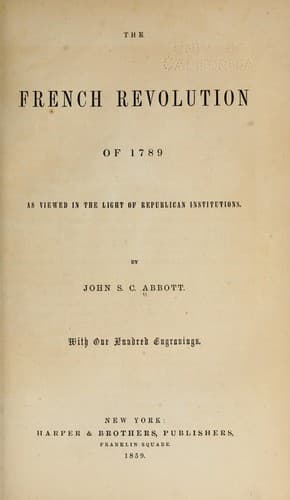
The French Revolution of 1789, as Viewed in the Light of Republican InstitutionsAbbott, John S. C. (John Stevens Cabot)
History
The French Revolution of 1789, as Viewed in the Light of Republican Institutions
Abbott, John S. C. (John Stevens Cabot)
France -- History -- Revolution, 1789-1799
The first and the third classes, the Aristocrats and the
ultra-Democrats, joined hand in hand to overthrow the Moderates, as the
middle party were called, each hoping thus to introduce the reign of
its own principles. Thus they both were ready to exasperate the masses
and to encourage violence. These were the two implacable foes against
whom the Revolution, and subsequently the Empire under Napoleon, had
ever to contend. Despotism and Jacobinism have ever been the two allied
foes against rational liberty in France.
The patriots of the middle, or moderate party, who had not as yet
assumed any distinctive name, for the parties in the Assembly were
but just beginning to marshal their forces for the fight, earnestly
deplored all scenes of violence. Such scenes only thwarted their
endeavors for the regeneration of France.
The Assembly now engaged with great eagerness in drawing up a
declaration of rights, to be presented to the people as the creed
of liberty. It was thought that if such a creed could be adopted,
based upon those self-evident truths which are in accordance with the
universal sense of right, the people might then be led to rally around
this creed with a distinct object in view.
For two months, from the 1st of August till the early part of October,
the Assembly was engaged in discussing the Bill of Rights and the
Constitution. But it was found that there had now suddenly sprung
up three Assemblies instead of one, each potent in its sphere, and
that between the three a spirit of rivalry and of antagonism was very
rapidly being engendered.
The first was the National Assembly at Versailles, originally
consisting of twelve hundred deputies, but now dwindled down by
emigration and other absence to about eight hundred.
The second was the municipal government of Paris, consisting of three
hundred representatives from the different sections or wards of the
city, and which held its sessions at the Hôtel de Ville. As Paris
considered itself France, the municipality of Paris began to arrogate
supreme power.
The third was the colossal assembly of the Parisian populace, an
enormous, tumultuous, excitable mass, every day gathered in the garden
of the Palais Royal. This assembly, daily becoming more arrogant,
often consisted of from ten to twelve thousand. It was continually in
session. Here was the rendezvous for all of the lower orders, men and
women. Impassioned orators, of great powers of popular eloquence, but
ignorant and often utterly unprincipled, mounted tables and chairs, and
passionately urged all their crude ideas.
Public-domain text, read in full here on John Shaqi.
Reviews
Reviews
No reviews yet
Be the first to share your thoughts on this work.
Elsewhere in the archive
Join the Discussion
Join the discussion
Sign in to leave a comment or review.
Sign InorCreate an account