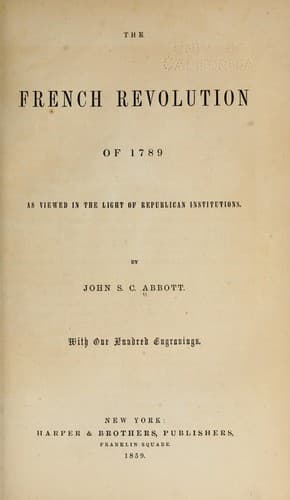
The French Revolution of 1789, as Viewed in the Light of Republican InstitutionsAbbott, John S. C. (John Stevens Cabot)
History
The French Revolution of 1789, as Viewed in the Light of Republican Institutions
Abbott, John S. C. (John Stevens Cabot)
France -- History -- Revolution, 1789-1799
The Assembly now turned its attention to the organization of the
legislative body of the nation. The all-absorbing question was whether
the National Congress or Parliament should meet in one chamber or in
two; if in two, whether the upper house should be an aristocratic,
hereditary body, like the House of Lords in the British Parliament,
or an elective republican Senate, as in the American Congress. The
debate was long and impassioned. The people would not consent to an
_hereditary_ House of Lords, which would remain an almost impregnable
fortress of aristocratic usurpation. They were, however, inclined to
assent to an upper house to be composed exclusively of the clergy and
the nobles, but to be elected by the people. To this arrangement the
haughty lords peremptorily refused their assent. They were equally
opposed to an _election_ to the upper house even by the nobles and
the clergy, for the high lords and great dignitaries of the Church
looked down upon the lower nobility and upon the working clergy with
almost as much contempt as they regarded the people. Finding the nobles
hostile to any reasonable measure, the masses of the people became
more and more irritated. The vast gathering at the Palais Royal soon
became unanimous in clamoring for but one chamber. The lords were their
enemies, and in a house of lords they could see only a refuge for old
and execrable feudality and an insurmountable barrier to reform.[211]
When the vote was taken there were five hundred for a single chamber
and but one hundred for two chambers.[212] It was unquestionably a
calamity to France that two chambers could not have been organized. But
the infatuation of the nobles now for the second time prevented this
most salutary check upon hasty legislation.
The next question to be decided was the _royal veto_. All were united
that the laws should be presented to the king for his sanction or
refusal. The only question was whether the veto should be absolute
or limited. That of the King of England is absolute. That of the
President of the United States is limited. All France was agitated
by this question. Here the aristocracy made their last desperate
stand and fought fiercely. Many of the popular party, alarmed in view
of the rapid progress of events, advocated the absolute veto. Its
inconsistency, however, with all enlightened principles of liberty was
too apparent to be concealed. That the caprice of a single man, and
he perhaps weak or dissolute, should permanently thwart the decrees
of twenty-seven millions of people appeared so absurd that the whole
nation rose against it.
Public-domain text, read in full here on John Shaqi.
Reviews
Reviews
No reviews yet
Be the first to share your thoughts on this work.
Elsewhere in the archive
Join the Discussion
Join the discussion
Sign in to leave a comment or review.
Sign InorCreate an account