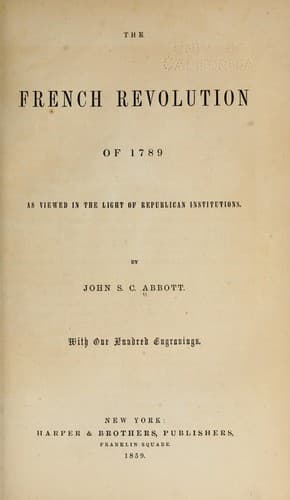
The French Revolution of 1789, as Viewed in the Light of Republican InstitutionsAbbott, John S. C. (John Stevens Cabot)
History
The French Revolution of 1789, as Viewed in the Light of Republican Institutions
Abbott, John S. C. (John Stevens Cabot)
France -- History -- Revolution, 1789-1799
The fate of liberty seemed to depend upon this question, as the
absolute veto would enable the court, through the king, to annul every
popular measure. The crowds in Paris became turbulent and menacing.
Threatening letters were sent to members of the National Assembly. The
Parisian mob even declared its determination to march to Versailles,
and drive from the Assembly those in favor of the veto. The following
letter, addressed to the Bishop of Langres, then president of the
Assembly, may be presented as a specimen of many with which the hall
was flooded:
"The patriotic assembly of the Palais Royal have the honor to make it
known to you, sir, that if the aristocratic faction, formed by some
of the nobility and the clergy, together with one hundred and twenty
ignorant and corrupt deputies, continue to disturb the general harmony,
and still insist upon the absolute veto, fifteen hundred men are ready
to _enlighten_ their country seats and houses, and particularly your
own."[213]
"I shall never forget," writes Dumont, "my going to Paris one of those
days with Mirabeau, and the crowd of people we found waiting for his
carriage about Le Say the bookseller's shop. They flung themselves
before him, entreating him, with tears in their eyes, not to suffer the
absolute veto."
"They were in a phrensy. 'Monsieur le Comte,' said they, 'you are the
people's father. You must save us. You must defend us against those
villains who are bringing back despotism. If the king gets this veto,
what is the use of the National Assembly? We are all slaves! All is
undone.'[214] There was as much ability in the tumultuous gathering at
the Palais Royal as in the National Assembly, and more of impassioned,
fiery eloquence. This disorderly body assumed the name of the Patriotic
Assembly, and was hourly increasing in influence and in the boldness of
its demands. Camille Desmoulins was one of its most popular speakers.
He was polished, keen, witty, having the passions of his ever-varying,
ever-excitable audience perfectly at his command. He could play with
their emotions at his pleasure, and though not an _earnest_ man, for
jokers seldom are, he was eager and reckless."[215]
St. Huruge was, however, the great orator of the populace, the
Mirabeau of the Palais Royal. A marquis by birth, he had suffered long
imprisonment in the Bastille by _lettre de cachet_. Oppression had
driven him mad, and _he_ was thoroughly earnest. Every day he uttered
the most fierce and envenomed invectives against that aristocratic
power by whose heel he had been crushed. He was a man of towering
stature, impassioned gesticulation, and with a voice like the roar of a
bull.
Public-domain text, read in full here on John Shaqi.
Reviews
Reviews
No reviews yet
Be the first to share your thoughts on this work.
Elsewhere in the archive
Join the Discussion
Join the discussion
Sign in to leave a comment or review.
Sign InorCreate an account