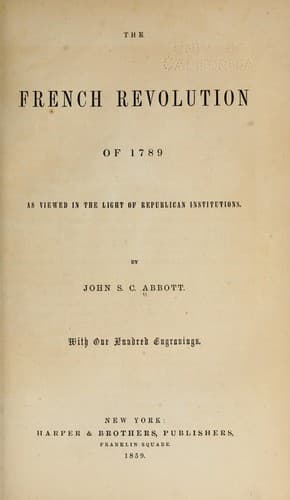
The French Revolution of 1789, as Viewed in the Light of Republican InstitutionsAbbott, John S. C. (John Stevens Cabot)
History
The French Revolution of 1789, as Viewed in the Light of Republican Institutions
Abbott, John S. C. (John Stevens Cabot)
France -- History -- Revolution, 1789-1799
In every nation there are thousands of the ignorant, degraded,
miserable, who have nothing to lose and something to hope from anarchy.
The inmates of the dens of crime and infamy, who are only held in check
by the strong restraints of law, rejoice in the opportunity to sack
the dwellings of the industrious and the wealthy, and to pour the tide
of ruin through the homes of the virtuous and the happy. This class
of abandoned men and women was appallingly increasing. They flocked
to the city from all parts of the kingdom, and Paris was crowded with
spectres, emaciate and ragged, whose hideous and haggard features spoke
only of vice and misery. Sièyes expressed to Mirabeau his alarm in view
of the portentous aspect of affairs.
"You have let the bull loose," Mirabeau replied, "and now you complain
that he butts with his horns."[217]
Much has been said respecting the _motives_ which influenced Mirabeau.
Whatever his motives may have been, his conduct was consistent. All
his words and actions were in favor of liberty sustained by strong
law. He wished for the overthrow of aristocratic insolence and
feudal oppression, from which he had so severely suffered. He wished
to preserve the monarchical form of government, and to establish a
constitution which should secure to all the citizens equality of
rights.[218]
Feudality was now destroyed, and a free constitution adopted. Still,
business was stagnant, the poor destitute of employment and in a
state of starvation. As an act of charity, seventeen thousand men
were employed by the municipality of Paris digging on the heights of
Montmartre at twenty sous a day. The suffering was so great that the
office of the municipality was crowded with tradesmen and merchants
imploring employment on these terms. "I used to see," writes the mayor,
Bailly, "good tradespeople, mercers and goldsmiths, who prayed to
be admitted among the beggars employed at Montmartre in digging the
ground. Judge what I suffered."
The city government sunk two thousand dollars a day in selling bread
to the poor at less than cost; and yet there were emissaries of the
court buying up this bread and destroying it to increase the public
distress.[219] On the 19th day of August the city of Paris contained
food sufficient but for a single day. Bailly and La Fayette were in an
agony of solicitude. So great was the dismay in Paris, that all the
rich were leaving. Sixty thousand passports were signed at the Hôtel de
Ville in three months.[220]
Armed bands were exploring the country to purchase food wherever it
could be found, and convey it to the city. Six hundred of the National
Guard were stationed by day and by night to protect the corn-market
from attack. It is surprising that when the populace were in such
distress so few acts of violence should have been committed.[221]
Public-domain text, read in full here on John Shaqi.
Reviews
Reviews
No reviews yet
Be the first to share your thoughts on this work.
Elsewhere in the archive
Join the Discussion
Join the discussion
Sign in to leave a comment or review.
Sign InorCreate an account