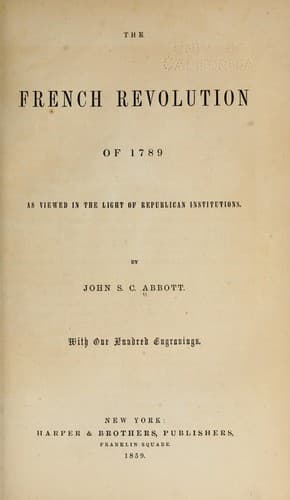
The French Revolution of 1789, as Viewed in the Light of Republican InstitutionsAbbott, John S. C. (John Stevens Cabot)
History
The French Revolution of 1789, as Viewed in the Light of Republican Institutions
Abbott, John S. C. (John Stevens Cabot)
France -- History -- Revolution, 1789-1799
The kind heart of the king was affected by this misery. He sent nearly
all his plate to be melted and coined at the mint for the relief of
the poor. This noble example inspired others. General enthusiasm was
aroused, and the hall of the National Assembly was crowded with the
charitable bringing voluntary contributions for the relief of the
poor. Rich men sent in their plate, patriotic ladies presented their
caskets of jewelry, and the wives of tradesmen, artists, and mechanics
brought the marriage gifts which they had received and the ornaments
which embellished their dwellings. Farmers sent in bags of corn,
and even poor women and children offered their mites. A school-boy
came with a few pieces of gold which his parents had sent to him for
spending-money. This overflowing of charity presented a touching
display of the characteristic magnanimity and impulsiveness of the
French people.[222]
[Illustration: PATRIOTIC CONTRIBUTIONS.]
But private charity, however profuse, is quite inadequate to the wants
of a nation. These sums were soon expended, and still the unemployed
poor crawled fasting and emaciated about the streets. Necker's plans
for loans were frustrated. No one would lend. To whom should he lend?
The old régime was dying; the new not yet born. In this terrible
emergency Necker proposed the desperate measure of imposing a tax of
one quarter of every man's income, declaring that there was no other
refuge from bankruptcy. The interest upon the public debt could no
longer be paid, the wages of the soldiers were in arrears, and the
treasury utterly empty. The proposal frightened the Assembly, but
Mirabeau ascended the tribune, and in one of his most impassioned
appeals carried the measure by acclamation.[223] The distracted state
of the kingdom, however, prevented the act thus enthusiastically
adopted from being carried into effect.[224]
Thomas Jefferson was at this time, as we have before mentioned, the
American minister in Paris, and was constantly consulted by the leaders
of the Revolution. In his memoirs, speaking of these events, he writes,
"The first question, whether there should be a king, met with no
opposition, and it was readily agreed that the government of France
should be monarchical and hereditary.
"Shall the king have a negative on the laws? Shall that negative
be absolute, or suspensive only? Shall there be two chambers of
legislation, or one only? If two, shall one of them be hereditary, or
for life, or for a fixed term; and named by the king or elected by the
people?
Public-domain text, read in full here on John Shaqi.
Reviews
Reviews
No reviews yet
Be the first to share your thoughts on this work.
Elsewhere in the archive
Join the Discussion
Join the discussion
Sign in to leave a comment or review.
Sign InorCreate an account