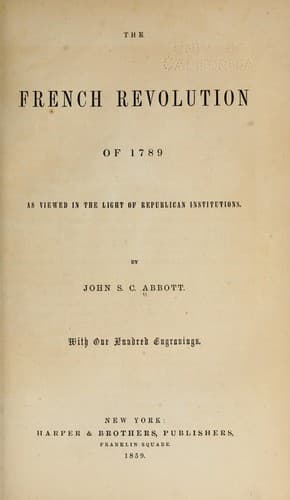
The French Revolution of 1789, as Viewed in the Light of Republican InstitutionsAbbott, John S. C. (John Stevens Cabot)
History
The French Revolution of 1789, as Viewed in the Light of Republican Institutions
Abbott, John S. C. (John Stevens Cabot)
France -- History -- Revolution, 1789-1799
"These questions found strong differences of opinion, and produced
repulsive combinations among the patriots. The aristocracy was cemented
by a common principle of preserving the ancient régime, or whatever
should be nearest to it. Making this their polar star, they moved in
phalanx, gave preponderance on every question to the minorities of
the patriots, and always to those who advocated the least change. The
features of the new constitution were thus assuming a fearful aspect,
and great alarm was produced among the honest patriots by these
dissensions in their ranks.
"In this uneasy state of things I received one day a note from the
Marquis de la Fayette, informing me that he should bring a party of six
or eight friends to ask a dinner of me the next day. I assured him of
their welcome. When they arrived, they were La Fayette himself, Dupont,
Barnave, Alexander Lameth, Blacon, Mounier, Maubourg, and Dagout. These
were leading patriots of honest but differing opinions, sensible of
the necessity of effecting a coalition by mutual sacrifices; knowing
each other, and not afraid therefore to unbosom themselves mutually.
This last was a material principle in the selection. With this view the
marquis had invited the conference, and had fixed the time and place,
inadvertently as to the embarrassment under which he might place me.
"The cloth being removed and wine set on the table, after the American
manner, the marquis introduced the objects of the conference by
summarily reminding them of the state of things in the Assembly, the
course which the principles of the Constitution were taking, and the
inevitable result, unless checked by more concord among the patriots
themselves. He observed that though he also had his opinion, he was
ready to sacrifice it to that of his brethren of the same cause; but
that a common opinion must now be formed, or the aristocracy would
carry every thing, and that, whatever they should now agree on, he, at
the head of the national force, would maintain.
"The discussions began at the hour of four, and were continued till ten
o'clock in the evening, during which time I was a silent witness to a
coolness and candor of argument unusual in the conflicts of political
opinion; to a logical reasoning and chaste eloquence disfigured by no
gaudy tinsel of rhetoric or declamation, and truly worthy of being
placed in parallel with the finest dialogues of antiquity, as handed
to us by Plato, by Xenophon, and Cicero. The result was that the king
should have a suspensive veto on the laws, that the Legislature should
be composed of a single body only, and that to be chosen by the people.
This concordat decided the fate of the Constitution. The patriots
all rallied to the principles thus settled, carried every question
agreeably to them, and reduced the aristocracy to insignificance and
impotence."[225]
FOOTNOTES:
Public-domain text, read in full here on John Shaqi.
Reviews
Reviews
No reviews yet
Be the first to share your thoughts on this work.
Elsewhere in the archive
Join the Discussion
Join the discussion
Sign in to leave a comment or review.
Sign InorCreate an account