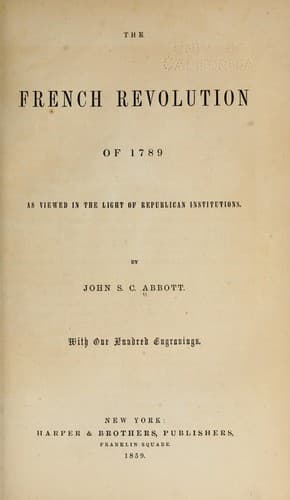
The French Revolution of 1789, as Viewed in the Light of Republican InstitutionsAbbott, John S. C. (John Stevens Cabot)
History
The French Revolution of 1789, as Viewed in the Light of Republican Institutions
Abbott, John S. C. (John Stevens Cabot)
France -- History -- Revolution, 1789-1799
[Footnote 211: The higher nobility of Great Britain consists of 26
dukes, 35 marquises, 217 earls, 65 viscounts, 191 barons. Each of
these takes the title of _lord_ and is entitled by birth to a seat in
the House of Lords, if we except the peers of Scotland and Ireland,
who have a seat with the lords only by deputation, the Scotch peers
choosing 16 and the Irish 28. There are, besides, six archbishops and
42 bishops, who, by virtue of their office, are styled _lords_ and
have a seat in the House of Lords. The lower nobility, consisting of
baronets and knights, have no privileges but the honor of their title.
They are somewhere between one and two thousand in number. The higher
nobility, including the dignitaries of the Church, six archbishops
and 42 bishops, in 1813 amounted to 554 families. The total revenue
of the _temporal nobility_, according to Colquhoun, was $25,000,000,
which makes an average of about $48,000 a year for each noble family.
According to the same authority, the total revenue of the _spiritual
lords_ was $1,200,000, which would average $25,000 a year for each. The
English say that those nobles are exceedingly valuable. They ought to
be. They cost enough. See Enc. Am., Art. Great Britain.]
[Footnote 212: Michelet. M. Rabaud de St. Etienne says 911 for one, 89
for two. Alison, without giving his authority, states 499 for one, 87
for two.]
[Footnote 213: The French Revolutions from 1789 to 1848, by T.W.
Redhead, vol. i., p. 59.]
[Footnote 214: Souvenirs sur Mirabeau, p. 156.]
[Footnote 215: "What will always astonish those who are acquainted
with the history of other revolutions is, that in this miserable
and famished state of Paris, denuded of all authority, there were,
on the whole, but very few serious acts of violence. One word, one
reasonable observation, occasionally a jest, was sufficient to check
them. On the first days only subsequent to the 14th of July there
were instances of violence committed. The people, full of the idea
that they were betrayed, sought for their enemies hap-hazard, and
were near making some cruel mistakes. M. de la Fayette interposed
several times at the critical moment, and was attended to. On these
occasions M. de la Fayette was truly admirable. He found in his heart,
in his love for order and justice, words and happy sayings above his
nature."--_Michelet_, vol. i., p. 227.]
Public-domain text, read in full here on John Shaqi.
Reviews
Reviews
No reviews yet
Be the first to share your thoughts on this work.
Elsewhere in the archive
Join the Discussion
Join the discussion
Sign in to leave a comment or review.
Sign InorCreate an account