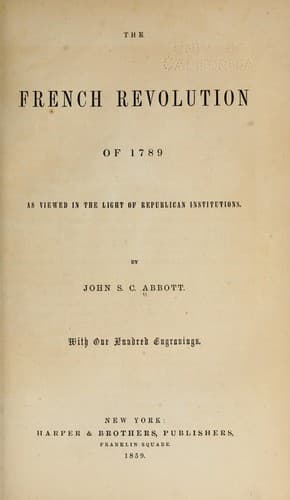
The French Revolution of 1789, as Viewed in the Light of Republican InstitutionsAbbott, John S. C. (John Stevens Cabot)
History
The French Revolution of 1789, as Viewed in the Light of Republican Institutions
Abbott, John S. C. (John Stevens Cabot)
France -- History -- Revolution, 1789-1799
[Footnote 216: "I hear it sometimes said that the French should
have contented themselves with laying down principles for their own
particular state, without spreading abroad those principles among
other nations. But is it really their fault if their principles
are so general as to be adapted to all men, of all times, and of
all countries? Nay, is it not a proof of the excellence of their
principles, which depend neither upon ages, nor on prejudices, nor on
climates? Have they invented them maliciously, and in order to impose
on kings and on the great? And is there any man so silly as to scruple
to rebuild his shattered dwelling, because others might be tempted
to re-edify theirs? If the French language is understood through all
Europe, are the French to blame? Ought they, through fear of being
listened to and imitated, to observe a strict silence, or speak a
language different from their own?"--_History of the Revolutions of
France, by M. Rabaud de St. Etienne_, p. 180.]
[Footnote 217: Dumont, vol. i., p. 66.]
[Footnote 218: "The particulars of Mirabeau's conduct are not yet
thoroughly known, but they are soon likely to be. I have had in my
hands several important documents, and especially a paper written in
the form of a profession of faith, which constituted his secret treaty
with the court. I am not allowed to give the public any of these
documents, or to mention the names of the holders. I can only affirm
what the future will sufficiently demonstrate, when all these papers
shall have been published.
"What I am able to assert with sincerity is, that Mirabeau never had
any hand in the supposed plots of the Duke of Orleans. Mirabeau left
Provence with a single object, that of combating arbitrary power, by
which he had suffered, and which his reason as well as his sentiments
taught him to consider as detestable. In his manners there was great
familiarity, which originated in a feeling of his strength. Hence it
was that he was frequently supposed to be the friend and accomplice
of many persons with whom he had no common interest. I have said,
and I repeat it, he had no party. Mirabeau remained poor till his
connection with the court. He then watched all parties, strove to make
them explain themselves, and was too sensible of his own importance to
pledge himself lightly."--_Hist, of the Fr. Rev., by M.A. Thiers_, vol.
i., p. 94.]
[Footnote 219: Histoire de la Revolution Française, par Villiaumé, p.
54.]
[Footnote 220: Revolutions de Paris, t. 11, No. 9, p. 8.]
Public-domain text, read in full here on John Shaqi.
Reviews
Reviews
No reviews yet
Be the first to share your thoughts on this work.
Elsewhere in the archive
Join the Discussion
Join the discussion
Sign in to leave a comment or review.
Sign InorCreate an account