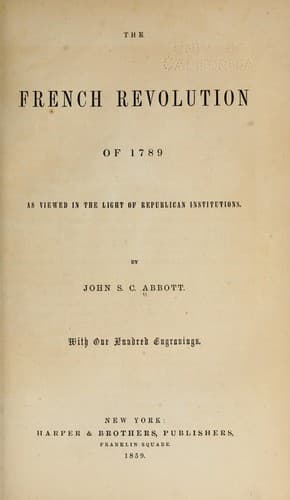
The French Revolution of 1789, as Viewed in the Light of Republican InstitutionsAbbott, John S. C. (John Stevens Cabot)
History
The French Revolution of 1789, as Viewed in the Light of Republican Institutions
Abbott, John S. C. (John Stevens Cabot)
France -- History -- Revolution, 1789-1799
The morning of the 5th of October dawned, dark, cold, and stormy.
A dismal rain flooded the streets. There were thousands in Paris
that morning who had eaten nothing for thirty hours.[228] The women,
in particular, of the humbler class, were in an awful state of
destitution and misery. The populace of Paris were actually starving.
An energetic woman, half delirious with woe, seized a drum, and strode
through the streets beating it violently, occasionally shrieking,
"Bread! bread!" She soon collected a crowd of women, which rapidly
increased from a few hundred to seven or eight thousand. The men gazed
with wonder upon this strange apparition, such as earth had, perhaps,
never seen before. Like a swelling inundation the living flood rolled
through the streets, and soon the cry was heard, "To Versailles!" As by
a common instinct, the tumultuous mass rushed along by the side of the
Tuileries and through the Elysian Fields toward Versailles. A few of
the more fierce and brutal of the women had guns or pistols. Chancing
to find a couple of cannon, they seized them, and also horses to drag
the ponderous engines, upon which female furies placed themselves
astride, singing revolutionary songs.
[Illustration: THE WOMEN OF PARIS MARCHING TO VERSAILLES.]
La Fayette gazed appalled upon the strange phenomenon. The troops of
the National Guard refused to arrest their course, declaring that they
could not resist starving women, who were going to implore bread of
their king. La Fayette was powerless. He had under arms that morning
thirty-five thousand troops, cavalry, infantry, and artillery. He could
only follow the women, to watch the opening of events. Behind these
troops advancing in all the glittering panoply of war, followed a
straggling mass of, no one can tell how many thousands of the populace
of Paris, of all classes, characters, conditions. The city seemed
emptied of its inhabitants, as the road to Versailles, ten or twelve
miles in length, was filled with the tumultuous multitude. No one,
apparently, had any definite object, but each one was going to see what
the others would do.
Couriers were sent forward to warn the king and queen of the impending
peril. The good-natured, silly king had gone to Meudon to amuse
himself in chasing hares. Nothing can more conclusively show his utter
incapacity to govern a great kingdom, than that he should have been so
employed at such an hour. The king was sent for, and speedily returned
to Versailles. Marie Antoinette had all the energy and heroism of her
mother, Maria Theresa. When entreated immediately to secure her escape
with her two children, she replied,
"Nothing shall induce me to be separated from my husband. I know that
they seek my life; but I am the daughter of Maria Theresa, and have
learned not to fear death."
Public-domain text, read in full here on John Shaqi.
Reviews
Reviews
No reviews yet
Be the first to share your thoughts on this work.
Elsewhere in the archive
Join the Discussion
Join the discussion
Sign in to leave a comment or review.
Sign InorCreate an account