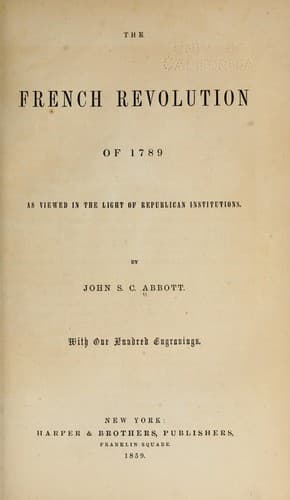
The French Revolution of 1789, as Viewed in the Light of Republican InstitutionsAbbott, John S. C. (John Stevens Cabot)
History
The French Revolution of 1789, as Viewed in the Light of Republican Institutions
Abbott, John S. C. (John Stevens Cabot)
France -- History -- Revolution, 1789-1799
The king was entreated to escape, but he was fearful that his flight
might embolden the Assembly to declare the throne vacant, and to place
the crown upon the head of the Duke of Orleans, who had, with that
object probably in view, vociferously espoused the popular cause.
From the windows of Versailles the royal family soon descried the
vast multitude plodding along through the mud and the rain as they
approached Versailles. It is said that there were some men in the
mob, disguised as women, who gave impulse and direction to the mass.
A man by the name of Maillard, of gigantic stature, and possessed of
wonderful tact, succeeded in obtaining the post of leader. In this
alarming state of affairs, the king sent to the Assembly a partial
acceptance of the Constitution. As the Assembly were discussing this
question, the women arrived at the hall. Maillard entered, and the
women crowded after him. Respectfully, but earnestly, on behalf of the
women, he represented the starving condition of Paris, and complained
of the insult which the nation had received in the fête at the palace.
It was now three o'clock in the afternoon. The rain was still falling.
A dark, stormy night was at hand, and the streets of Versailles were
filled with countless thousands of the most desperate men and women,
utterly destitute of shelter. The Assembly, in alarm, requested their
president, M. Mounier, to go to the palace and petition for fresh
measures of relief. M. Mounier was compelled to allow twelve women to
accompany him. The king received them kindly. The women had adroitly
selected, as the leader of their deputation, a very beautiful young
flower-girl, but seventeen years of age, of remarkably graceful form
and lovely features. The girl, overcome by her sensations, endeavored
in vain to speak, and fainted. The king took her in his arms,
embraced her as if she had been his child, and was so paternal that
he completely won the hearts of all the women. They left the palace
with such enthusiastic accounts of the goodness of the king, that the
Amazons on the outside accused them of having been bribed, and, in
their rage, were ready to tear them in pieces. The poor flower-girl
would have been hanged with garters to a lamp-post had not the soldiers
rescued her.
Public-domain text, read in full here on John Shaqi.
Reviews
Reviews
No reviews yet
Be the first to share your thoughts on this work.
Elsewhere in the archive
Join the Discussion
Join the discussion
Sign in to leave a comment or review.
Sign InorCreate an account