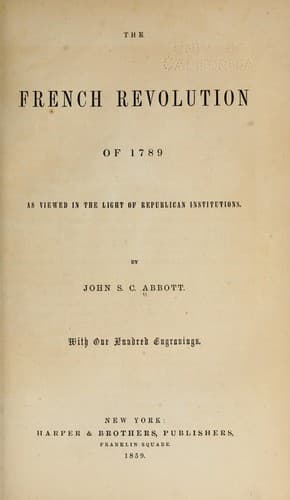
The French Revolution of 1789, as Viewed in the Light of Republican InstitutionsAbbott, John S. C. (John Stevens Cabot)
History
The French Revolution of 1789, as Viewed in the Light of Republican Institutions
Abbott, John S. C. (John Stevens Cabot)
France -- History -- Revolution, 1789-1799
The right of suffrage was extended to all male citizens twenty-five
years of age, who had resided in the electoral district one year, who
had paid a direct tax amounting to the value of three days' labor,
about sixty cents, who were not in the condition of servants, and
who were enrolled in the National Guard. These were called _active_
citizens. The rest of the population were deemed _passive_ citizens.
To be eligible to _office_ either as a magistrate or a representative,
it was required that one should pay a direct tax of about ten dollars,
and also be a landholder. The aristocrats considered this extension of
the right of suffrage as awfully radical and democratic. On the other
hand the democracy, from its lower depths, exclaimed with the utmost
vehemence and indignation against the restriction of the right of
suffrage and of office to tax-payers and property-holders.
"There is but one united voice," cried Camille Desmoulins, "in the city
and in the country, against this ten-dollar decree (_le décret du marc
d'argent_). It is constituting in France an aristocratic government,
and it is the most signal victory which the aristocrats have yet
gained in the Assembly. To demonstrate the absurdity of the decree it
is necessary but to mention that Rousseau, Corneille, Mably, under
it could not have been eligible. As for you, ye despicable priests,
ye lying cheating knaves, do you see that you make even your God
ineligible?[243] Jesus Christ, whom you recognize as divine, you thrust
out into the ranks of the mob. And do you wish that I should respect
you, ye priests of an ignominious God (_d'un Dieu proletaire_), who is
not even an active citizen? Respect that poverty which Jesus Christ has
ennobled."[244]
Such fierce appeals produced a profound and exasperating impression
upon the army of two hundred thousand beggars in Paris and upon the
millions utterly impoverished in France. "We have overthrown the
aristocracy of birth," the orators of the populace exclaimed, "only
to introduce the still more hateful aristocracy of the purse." The
working clergy, who were among the foremost in favor of reform, were
almost to a man efficient members of the moderate party, and cordially
co-operated with La Fayette in the endeavor to prevent liberty from
being whelmed in lawlessness. The clergy had great influence, and
hence the venom of the popular speakers and writers was perseveringly
directed against them.[245]
Public-domain text, read in full here on John Shaqi.
Reviews
Reviews
No reviews yet
Be the first to share your thoughts on this work.
Elsewhere in the archive
Join the Discussion
Join the discussion
Sign in to leave a comment or review.
Sign InorCreate an account