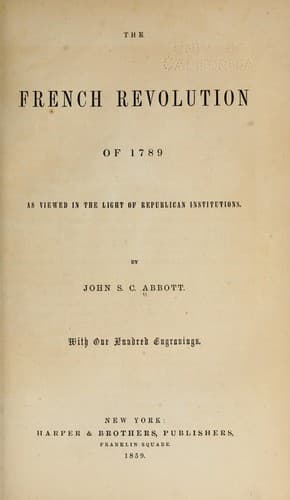
The French Revolution of 1789, as Viewed in the Light of Republican InstitutionsAbbott, John S. C. (John Stevens Cabot)
History
The French Revolution of 1789, as Viewed in the Light of Republican Institutions
Abbott, John S. C. (John Stevens Cabot)
France -- History -- Revolution, 1789-1799
The Assembly then abolished the oppressive duty upon salt.[246] The
old parliaments of the old provinces, as corrupt bodies as have
perhaps ever existed, and the subservient instruments of aristocratic
oppression, were suppressed, and new courts of a popular character
substituted in their place. All trials were ordered to be public; no
punishment, on accusation for crime, could be inflicted unless by a
vote of two thirds of the court. The penalty of death required a vote
of four fifths. The revocation of the Edict of Nantes was blotted out,
and thus some thousands of Protestants who had long been banished
from France were permitted to return and to enjoy all their political
rights. It was decreed that all citizens, of whatever condition, should
be subject to the same laws and judged by the same tribunals. Those
accused of crime were to be tried by jury, but not till a court had
previously determined that the evidence against them was sufficiently
strong to warrant their arrest. It is remarkable that both Robespierre
and Marat were most earnest in their endeavors to abrogate the
death-penalty. During this discussion Dr. Guillotin urged the adoption,
in capital punishment, of a new machine which he had invented.
"With my machine," said the doctor, "I can clip off your head in the
twinkling of an eye without your feeling it."
These words, most earnestly uttered, caused a general burst of laughter
in the Assembly. But a few months passed ere many of those deputies
were bound to the plank and experienced the efficiency of the keen
blade. The introduction of the guillotine was intended as a measure of
humanity. The unfortunate man doomed to death was thus to be saved from
needless suffering.[247]
The measures adopted by the Constituent Assembly seem to republican
eyes just and moderate. Experience, it is true, has proved that it is
safer to have two houses of legislation, a senate and a lower house,
than one, but the subsequent decrees passed by this one house were
manifestly dictated, not by passion, but by patriotism and a sense of
right.[248]
The clergy now made immense efforts to rouse the peasantry all over
the kingdom to oppose the Revolution. Religious fanaticism exhausted
all its energies. The parliaments also of the old provinces, composed
exclusively of the nobles, roused themselves anew and were vehement in
remonstrances and protests. They became active agents in organizing
opposition, in maligning the action of the Assembly, and in inciting
the credulous multitude to violence. The Assembly punished the
parliaments by abolishing them all.
The court bitterly accused the Assembly of a usurpation of power, which
called from Mirabeau a reply which electrified France.
Public-domain text, read in full here on John Shaqi.
Reviews
Reviews
No reviews yet
Be the first to share your thoughts on this work.
Elsewhere in the archive
Join the Discussion
Join the discussion
Sign in to leave a comment or review.
Sign InorCreate an account