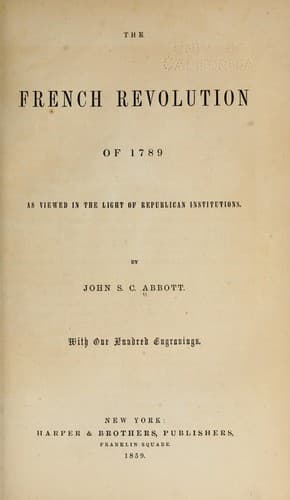
The French Revolution of 1789, as Viewed in the Light of Republican InstitutionsAbbott, John S. C. (John Stevens Cabot)
History
The French Revolution of 1789, as Viewed in the Light of Republican Institutions
Abbott, John S. C. (John Stevens Cabot)
France -- History -- Revolution, 1789-1799
A Protestant, M. Rabaud de St. Etienne, was chosen president of the
Assembly--a position at that time higher than that of the throne. He
was the son of the celebrated Protestant martyr of Cevennes, who for
long years had been hunted like a wild beast, as he hid in dens in
the forest, escaping from the ferocity of religious persecution. The
venerable parent was still living, and received from his son a letter
containing the declaration, "The president of the National Assembly is
at your feet."
The higher ecclesiastics were, however, exasperated by this triumph
of religious liberty. They succeeded, in Montauban and in Nimes, in
exciting a Roman Catholic mob against the Protestants. The ignorant
populace, roused by superstition, seized their arms, shouted "Down
with the nation!" and fell with the most cruel butchery upon the
Protestants. The violent insurrection was, however, soon quelled,
and without any acts of retaliatory vengeance.[250] The bishops
anathematized every priest friendly to the Revolution, and designated
all such to the hatred and contempt of the fanatic populace. The bishop
who, under the old régime, had enjoyed an income of eight hundred
thousand francs ($160,000), and was rejoicing in his palaces, horses,
and concubines, invoked the wrath of God upon the curate who was now
receiving twelve hundred francs ($240) from the nation. The power of
the papal ecclesiastics was so strong that most of the humble curates
were eventually compelled to abandon the Revolution and rally again
around the sceptre of the Pope.
The air was still filled with rumors of plots to disperse the Assembly
and carry the king off to the protection of the royalist army at Metz,
where he could be forced by the nobles to sanction their course, in
invading France with foreign armies. On the 25th of December the
Marquis of Favrus was arrested, accused of forming a plot to seize
the king with an army of thirty thousand men, and to assassinate La
Fayette and Bailly. It was said that twelve hundred horse were ready at
Versailles to carry off the king, and that a powerful force, composed
of Swiss and Piedmontese, was organized to march upon Paris. The king's
brother, the Count of Provence, subsequently Louis XVIII., was reported
as in the plot, and to have supplied the conspirators with large sums
of money. Louis was willing to be abducted as if by violence, but was
not willing to assume any responsibility by engaging in measures for
escape. He assumed the attitude of contentment, and with such apparent
cordiality professed co-operation in the measures of the Assembly for
the regeneration of France that many supposed that he had honestly
espoused the popular cause.
FOOTNOTES:
[Footnote 233: For overwhelming evidence that such was the state of the
public mind, see Weber, vol. i., p. 257; Beaulieu, vol. ii., p. 203;
Amis de la Liberté, vol. iv., p. 2-6; Michelet, vol. i., p. 284.]
Public-domain text, read in full here on John Shaqi.
Reviews
Reviews
No reviews yet
Be the first to share your thoughts on this work.
Elsewhere in the archive
Join the Discussion
Join the discussion
Sign in to leave a comment or review.
Sign InorCreate an account