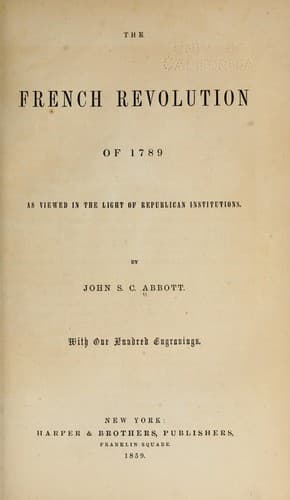
The French Revolution of 1789, as Viewed in the Light of Republican InstitutionsAbbott, John S. C. (John Stevens Cabot)
History
The French Revolution of 1789, as Viewed in the Light of Republican Institutions
Abbott, John S. C. (John Stevens Cabot)
France -- History -- Revolution, 1789-1799
"You ask," he said, "how, from being deputies, we have made ourselves
a convention. I will tell you. The day when, finding our assembly-room
shut, bristling and defiled with bayonets, we hastened to the first
place that could contain us, and swore that we would perish rather
than abandon the interests of the people--on that day, if we were
not a convention, we became one. Let them now go and hunt out of the
useless nomenclature of civilians the definition of the words National
Convention! Gentlemen, you all know the conduct of that Roman who, to
save his country from a great conspiracy, had been obliged to outstep
the powers conferred upon him by the laws. A captious tribune required
from him the oath that he had respected them. He thought, by that
insidious proposal, to leave the consul no alternative but perjury or
an embarrassing avowal. 'I swear,' said that great man, 'that I have
saved the republic.' Gentlemen, we also swear that we have saved the
commonwealth."
This sublime apostrophe brought the whole Assembly to its feet. The
charge of usurpation was not repeated.
A great effort was at the same time made to compel the Assembly to
adopt the resolution that the "Catholic, Apostolic, and Roman religion
is, and shall ever be, the religion of the nation, and that its worship
is the only one authorized." As one of the court party was urging this
resolve, and quoting, as a precedent, some intolerant decree of Louis
XIV., Mirabeau sent dismay to the heart of the court by exclaiming,
"And how should not every kind of intolerance have been consecrated in
a reign signalized by the revocation of the Edict of Nantes?"
Then, pointing to a window of the Louvre, he continued, in deep and
solemn tones which thrilled through every heart,
"Do you appeal to history? Forget not that from this very hall I behold
the window whence a king of France, armed against his people by an
execrable faction that disguised personal interest under the cloak of
religion, fired his musket and gave the signal for the massacre of St.
Bartholomew!"
The effect was electric, and the spirit of intolerance was crushed.
The true Christian charity which the Assembly assumed was cordially
accepted by the mass of the nation. We love to record the fact that
the great majority of the Catholic population were delighted to see
the Protestants restored to their civil and religious rights. Even
Michelet, hostile as he is to all revealed religion, testifies: "The
unanimity was affecting, and one of the sights the most worthy to call
down the blessing of God upon earth. In many parts the Catholics went
to the temple of the Protestants, and united with them to return thanks
to Providence together. On the other hand the Protestants attended at
the Catholic _Te Deum_. Far above all the altars, every temple and
every church, a divine ray had appeared in heaven."[249] In every place
where the Protestants were in the majority they presented the most
affecting spectacle of fraternity.
Public-domain text, read in full here on John Shaqi.
Reviews
Reviews
No reviews yet
Be the first to share your thoughts on this work.
Elsewhere in the archive
Join the Discussion
Join the discussion
Sign in to leave a comment or review.
Sign InorCreate an account