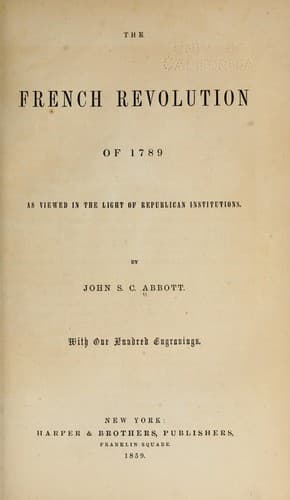
The French Revolution of 1789, as Viewed in the Light of Republican InstitutionsAbbott, John S. C. (John Stevens Cabot)
History
The French Revolution of 1789, as Viewed in the Light of Republican Institutions
Abbott, John S. C. (John Stevens Cabot)
France -- History -- Revolution, 1789-1799
Thus far the reforms adopted had been, on the whole, most eminently
wise, and such as the welfare of the nation imperiously demanded. Had
the privileged classes acceded, as they ought to have done, to these
measures of justice, and contributed their influence in favor of law
and order, all might have been well, and the Iliad of woes which
succeeded might never have been known. But the nobles and the higher
clergy did every thing in their power to stimulate the mob to violence,
to fill France with lawlessness and blood, that they might more
effectually appeal to religious fanaticism at home and to despotism
abroad to forge chains and rivet them anew upon the enfranchised people.
Every effort was now made to combine the clergy against the
Revolution--to rouse the ignorant and superstitious masses with the cry
that religion was in danger, and to march the armies of surrounding
monarchies in a war of invasion upon France. The nobles of the Church
and the State were responsible for that terrific outburst of the mob,
which might easily have been repressed if they would have united with
the true patriots in favor of liberty and of law.[252]
In many of the rural districts the priests roused the fanatic populace
to forcible resistance. Many of the priests had been in a condition
of almost compulsory subservience to the higher clergy. Trained to
_obedience_ as the primal law of the Church, they combined their
efforts with those of the exasperated nobility, and thus, in several
of the remote sections of France, mobs were instigated against the
Revolution. Here commenced the conflict between the people and the
clergy. Pure democracy and true Christianity meet and embrace. They
have but one spirit--fraternity, charity. Despotism and ecclesiasticism
are also natural congenial allies. The pope and the king, the cardinal
and the duke, all over Europe became accomplices.
The Assembly, with much delicacy, invited the king himself to fix the
income necessary for the suitable support of the crown. He fixed it at
twenty-five millions of francs ($5,000,000). This enormous salary, two
hundred times as much as the President of the United States receives,
was instantly voted by acclamation. There were but four votes in
opposition. Nothing can more conclusively show than this the kindly
feelings of the people toward the monarch, and the _then_ desire merely
to ingraft the institutions of liberty upon the monarchy.
Public-domain text, read in full here on John Shaqi.
Reviews
Reviews
No reviews yet
Be the first to share your thoughts on this work.
Elsewhere in the archive
Join the Discussion
Join the discussion
Sign in to leave a comment or review.
Sign InorCreate an account