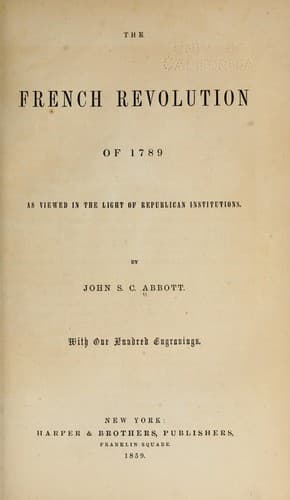
The French Revolution of 1789, as Viewed in the Light of Republican InstitutionsAbbott, John S. C. (John Stevens Cabot)
History
The French Revolution of 1789, as Viewed in the Light of Republican Institutions
Abbott, John S. C. (John Stevens Cabot)
France -- History -- Revolution, 1789-1799
The Revolution had humanely extended its helping hand to all the
debased and defrauded classes, to the Protestants, the Jews, the
negroes, the slaves, the play-actors. The relentless proscription of
play-actors is one of the most remarkable of the contradictions and
outrages of the old régime. They were doubtless a very worthless set
of men and women; but that the Church should have refused them either
marriage or burial is indeed extraordinary. "Oh, barbarous prejudices!"
exclaimed Michelet. "The two first men of England and France, the
author of _Othello_ and of _Tartufe_, were they not comedians?"
Notwithstanding the general decree of democratic enfranchisement
pronounced by the Assembly, the world-renowned Talma, having applied
to the Church for the rite of marriage, which the Church alone could
solemnize, met with a peremptory refusal. He sent the following
characteristic petition to the National Assembly:
"I implore the succor of the constitutional law, and claim the rights
of a citizen, from which rights the Constitution does not exclude me
because I am a member of the theatrical profession. I have chosen a
companion to whom I wish to be united by the ties of marriage. My
father has given his consent. I have called upon the curé of St.
Sulpice for the publication of the banns. After a first refusal I
have served upon him a judicial summons. He replies to the sheriff
that he has referred the matter to his ecclesiastical superiors, and
is instructed by them that the Church refuses to perform the rites of
marriage for a play-actor unless he first renounces that profession.
I can, it is true, renounce my profession, be married, and resume
my profession again the next day. But I do not wish to show myself
unworthy of that religion which they invoke against me, and unworthy of
the Constitution in thus accusing your decrees of error and your laws
of powerlessness."[253]
It was in such ways as these that the Romish Church began to throw
every possible obstacle in the way of liberty, and to exasperate the
people, rejoicing in their new enfranchisement.
Public-domain text, read in full here on John Shaqi.
Reviews
Reviews
No reviews yet
Be the first to share your thoughts on this work.
Elsewhere in the archive
Join the Discussion
Join the discussion
Sign in to leave a comment or review.
Sign InorCreate an account