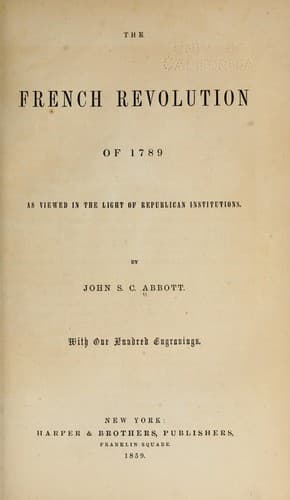
The French Revolution of 1789, as Viewed in the Light of Republican InstitutionsAbbott, John S. C. (John Stevens Cabot)
History
The French Revolution of 1789, as Viewed in the Light of Republican Institutions
Abbott, John S. C. (John Stevens Cabot)
France -- History -- Revolution, 1789-1799
Many of the most influential men in England contemplated with
admiration this immense reform, in which, to use the language of
Professor William Smyth, one of the most candid of English writers,
"the Constituent Assembly was supposed to have freed the country from
temporal and spiritual thraldom; the government had been rested on
free principles; the Bastille had been destroyed, _lettres de cachet_
abolished, feudal impediments and oppressions of every kind removed,
religious liberty established, the system of law made uniform, the
criminal jurisprudence reformed, monasteries abolished; and by making
the military force consist of the citizens of the country, freedom, and
all those new and weighty advantages, seemed to be forever secured from
the machinations of arbitrary power."
The _aristocracy_, however, of England and Europe were struck with
alarm. The emancipation of the _people_ in France threatened their
emancipation throughout the civilized world. Edmund Burke espoused the
cause of the aristocracy. With eloquence quite unparalleled he roused
England and Europe to war. In view of his fierce invectives Michelet
exclaims, in language which will yet be pronounced by the world as not
too severe,
"Mr. Pitt, feeling sure of the European alliance, did not hesitate
to say in open parliament that he approved of every word of Burke's
diatribe against the Revolution and against France--an infamous book,
full of calumny, scurrilous abuse, and insulting buffoonery; in which
the author compares the French to galley-slaves breaking their chains,
treads under foot the declaration of the rights of man, tears it in
pieces and spits upon it. Oh! what a cruel, painful discovery. Those
whom we thought our friends are our most bitter enemies."[257]
Thirty thousand copies of Burke's memorable "Reflections" were sold
almost in a day. The sovereigns of Europe were so highly elated that
they transmitted to him their thanks. The nobles and the higher clergy
of France wrote to him letters of acknowledgment, and the nobility of
England lavished upon him their applause. These "Reflections" combined
aristocratic Europe against popular rights, and the people had no
resource left them but to defend their liberties with the sword.
FOOTNOTES:
[Footnote 251: For the speech in full, see Thiers, vol. i., p. 126.]
Public-domain text, read in full here on John Shaqi.
Reviews
Reviews
No reviews yet
Be the first to share your thoughts on this work.
Elsewhere in the archive
Join the Discussion
Join the discussion
Sign in to leave a comment or review.
Sign InorCreate an account