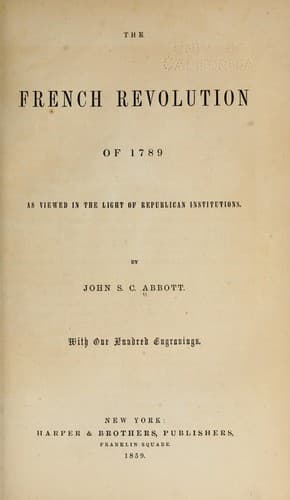
The French Revolution of 1789, as Viewed in the Light of Republican InstitutionsAbbott, John S. C. (John Stevens Cabot)
History
The French Revolution of 1789, as Viewed in the Light of Republican Institutions
Abbott, John S. C. (John Stevens Cabot)
France -- History -- Revolution, 1789-1799
[Footnote 252: M. Fromont, in his memoirs entitled "_Recueil de divers
Ecrits relatifs à la Revolution_," very frankly writes, "I repaired
secretly to Turin (January, 1790), to the French princes, to solicit
their approbation and their support. In a council which was held on my
arrival, I demonstrated to them that, if they would arm the partisans
of the altar and of the throne, and make the interests of religion
go hand in hand with those of royalty, it would save both. The real
argument of the revolutionists being force, I felt that the real
answer was force. Then, as at present, I was convinced of this great
truth--that _religious zeal alone can stifle the Republican mania_.
"In consequence of this dread (of the new order of things), they
secretly set at work the most efficacious means for ruining the
internal resources and for thwarting the proposed plans, several of
which were calculated to effect the re-establishment of order, if they
had been wisely directed and supported."]
[Footnote 253: "There is no country in the world," says Voltaire,
"where there are so many contradictions as in France. The king gives
the actors wages, and the curé excommunicates them."]
[Footnote 254: "The whole of Europe--on the one hand Austria and
Russia, on the other England and Prussia--were gradually gravitating
toward the selfsame thought, the hatred of the Revolution. However,
there was this difference, that liberal England and philosophical
Prussia needed a little time in order to pass from one pole to the
other--to prevail upon themselves to give themselves the lie, to abjure
and disown their principles, and avow that they were the enemies of
liberty."--_Michelet_, p. 327.]
[Footnote 255: Memoirs of the Marquis of Ferrières.]
[Footnote 256: No one familiar with the writings of that day will
affirm that this description is too highly drawn. Upon this point
Patriots and Royalists agree. See Ferrières, t. ii., p. 89, on the part
of the Royalists, and Alphonse Esquiros, p. 38, on the part of the
Revolutionists.]
[Footnote 257: Michelet's French Revolution, p. 415.]
CHAPTER XX.
FLIGHT OF THE KING.
Riot at Nancy.--Prosecution of Mirabeau.--Issue of
Assignats.--Mirabeau's Interview with the Queen.--Four
political Parties.--Bishops refuse to take the Oath to the
Constitution.--Character of the Emigrants.--The King's Aunts attempt
to leave France.--Debates upon Emigration.--Embarrassment of the
Assembly.--Death of Mirabeau.--His Funeral.--The King prevented
from visiting St. Cloud.--Duplicity of the King.--Conference of the
Allies.--Their Plan of Invasion.--Measures for the Escape of the
King.--The Flight.
Public-domain text, read in full here on John Shaqi.
Reviews
Reviews
No reviews yet
Be the first to share your thoughts on this work.
Elsewhere in the archive
Join the Discussion
Join the discussion
Sign in to leave a comment or review.
Sign InorCreate an account