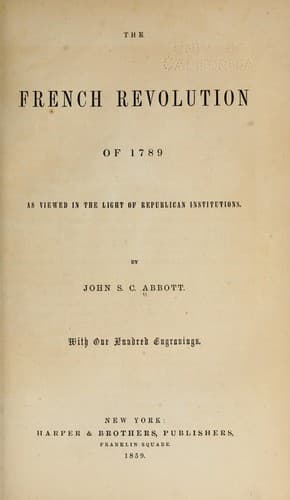
The French Revolution of 1789, as Viewed in the Light of Republican InstitutionsAbbott, John S. C. (John Stevens Cabot)
History
The French Revolution of 1789, as Viewed in the Light of Republican Institutions
Abbott, John S. C. (John Stevens Cabot)
France -- History -- Revolution, 1789-1799
The funeral of Mirabeau was the most imposing, popular, and extensive
of any recorded in history, always excepting that unparalleled display
of a nation's gratitude and grief which accompanied the transfer of the
remains of Napoleon from St. Helena to the Invalides. It is estimated
that four hundred thousand men took a part in the funeral pageant of
Mirabeau. The streets were draped in mourning, and pavements, windows,
balconies, and house-tops were thronged with sad and silent spectators.
La Fayette headed the immense procession, and was followed by the
whole Constituent Assembly, and by the whole club of Jacobins, who,
in a dense mass, assumed to be chief mourners on the occasion, though
Mirabeau had for some time held himself aloof from their tumultuous
meetings. It was eight o'clock in the evening before the procession
arrived at the Church of Saint Eustache, where a funeral oration was
pronounced by Cérutti. The arms of twenty thousand of the National
Guard were then discharged at once. The crash caused the very walls of
the church to rock, shivering to atoms every pane of glass.
It was now night, and, by the light of a hundred thousand torches,
the procession resumed its course. New instruments of music had been
invented, which were then heard for the first time--the trombone and
the tamtam. As the vast procession traversed the streets through the
gloomy shades of night, illumined by the glare of flickering torches,
with the tolling of bells, blending, now with the wail of the chant and
now with the pealing requiems of martial bands, all the elements of
sublimity seemed combined to affect the heart and overawe the soul. It
was near midnight when the sarcophagus was deposited in its tomb at the
Church of Saint Geneviève, over whose portal was inscribed these words,
"AUX GRANDS HOMMES LA PATRIE RECONNAISSANTE."
Mirabeau was the master-spirit of the Revolution. After his death
there were multitudes struggling for the leadership, with no man of
sufficient prominence to attain and retain it. The funeral of Mirabeau
was the funeral of emancipated France. From that hour the Revolution
was on the rush to ruin.
Public-domain text, read in full here on John Shaqi.
Reviews
Reviews
No reviews yet
Be the first to share your thoughts on this work.
Elsewhere in the archive
Join the Discussion
Join the discussion
Sign in to leave a comment or review.
Sign InorCreate an account