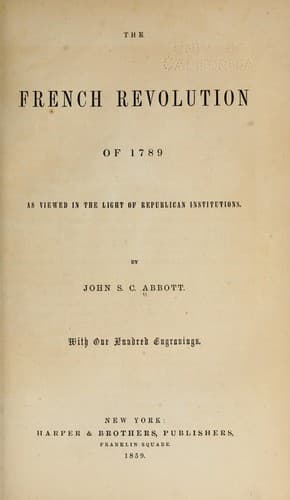
The French Revolution of 1789, as Viewed in the Light of Republican InstitutionsAbbott, John S. C. (John Stevens Cabot)
History
The French Revolution of 1789, as Viewed in the Light of Republican Institutions
Abbott, John S. C. (John Stevens Cabot)
France -- History -- Revolution, 1789-1799
"I admit," said he, "that a bad use is made of this liberty at the
present moment. But that by no means authorizes this absurd tyranny. I
beg you to remember that I have all my life combated against tyranny,
and that I will combat it wherever I find it. That popularity to which
I have aspired, and which I have enjoyed, is not a feeble reed. I will
thrust it deep into the earth, and will make it shoot up in the soil
of justice and of reason. And I now solemnly swear, if a law against
emigration is voted, I swear to disobey you."[265]
The Assembly was truly in a dilemma. They could not prohibit emigration
without grossly violating that declaration of rights which they had
just adopted with solemnities which had arrested the attention of the
world. They could not permit this flood of emigration without exposing
France to ruin; for it was well known that the nobles, with all the
wealth they could accumulate, were crossing the frontiers merely to
organize themselves into armies for the invasion of France.
Mirabeau never displayed more power than on this occasion, in overawing
and commanding the Assembly. He succeeded in arresting the measure.
This, however, was his last triumph. Disease was making rapid ravages,
his frame was exhausted, and death approached. A sudden attack of
colic confined him to his chamber, and soon all hope of recovery was
relinquished. He was still the idol of the people, and crowds, in
breathless silence, thronged around his abode, anxious to receive
bulletins of his health. The king and the people alike mourned, for
both were leaning upon that vigorous arm.
He could not repress an expression of satisfaction in view of his
labors and his accomplishments. To his servants he said, "Support this
head, the greatest in France." "William Pitt," he remarked, "is the
minister of preparations. He governs with threats. I would give him
some trouble if I should live."[266] On the morning of his death he
said to an attendant,
"Open the window. I shall die to-day. All that can now be done is to
envelop one's self in perfumes, to crown one's self with flowers,
to surround one's self with music, that one may sink quietly into
everlasting sleep."
Soon, in a paroxysm of extreme agony, he called for opium, saying, "You
promised to save me from needless suffering."
To quiet him a cup was presented, and he was deceived with the
assurance that it contained the desired fatal opiate. He swallowed
the draught, and in a moment expired, in the forty-second year of his
age. It was the 2d of April, 1791. His death caused profound grief.
All parties vied alike in conferring honor upon his remains. The
nation went into mourning, a magnificent funeral was arranged, and the
body was deposited in the tomb with pomp surpassing that which had
accompanied the burial of the ancient kings of France. Suspicions are
still cherished that Mirabeau died the victim of poison.[267]
Public-domain text, read in full here on John Shaqi.
Reviews
Reviews
No reviews yet
Be the first to share your thoughts on this work.
Elsewhere in the archive
Join the Discussion
Join the discussion
Sign in to leave a comment or review.
Sign InorCreate an account