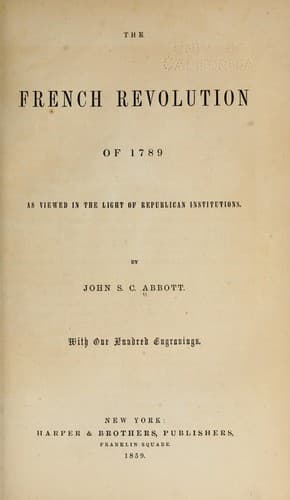
The French Revolution of 1789, as Viewed in the Light of Republican InstitutionsAbbott, John S. C. (John Stevens Cabot)
History
The French Revolution of 1789, as Viewed in the Light of Republican Institutions
Abbott, John S. C. (John Stevens Cabot)
France -- History -- Revolution, 1789-1799
A conference of the foreign powers was held on the 20th of May, 1791,
at Mantua, in Italy, where Leopold, Emperor of Austria, and brother of
Marie Antoinette, then chanced to be. At this conference Count d'Artois
appeared in behalf of the emigrants. Prussia was represented by Major
Bischofverder, England by Lord Elgin, and Louis XVI. by the Count de
Durfort. Several other of the kingdoms and principalities of Europe
were represented on the occasion. The Count de Durfort returned from
this conference to Louis XVI. in Paris, and brought him the following
secret declaration in the name of the Emperor Leopold:[270]
Austria engaged to assemble thirty-five thousand men on the frontiers
of Flanders. At the same time fifteen thousand men from the smaller
German States would attack Alsace. Fifteen thousand Swiss troops were
to be marched on Lyons, and the King of Sardinia, whose daughter
the Count d'Artois had married, was to assail Dauphiné. The king of
Spain, cousin of Louis XVI., was to gather twenty thousand troops
upon the slopes of the Pyrenees, to fall like an avalanche down upon
southern France. Prussia engaged to co-operate cordially. The King of
England, notwithstanding the eloquence of Burke's pamphlet, could not
yet venture to call upon the liberty-loving English to engage in this
infamous crusade against the independence and the liberty of a sister
kingdom. But the king, as Elector of Hanover, engaged to take an active
part in the war. A protest against the Revolution was to be drawn up
in the name of the whole house of Bourbon, whose _divine right_ to
despotism in France had been questioned by the French people, and this
protest was to be signed by those branches of the Bourbons who were
occupying the thrones of Spain, Naples, and Parma.[271]
Plans for the invasion having been thus arranged, Louis XVI. resolved
immediately to effect his escape to the frontier. He could then place
himself at the head of these foreign armies, and lash France into
obedience, and consign those patriots who had been toiling for liberty
to the dungeon and the scaffold.
Never was the condition of a nation more full of peril, or apparently
more hopeless. This impending destruction was enough to drive any
people into the madness of despair. It is hard to wear the fetters of
bondage even when one has never known any thing better. But, after
having once broken those chains and tasted the sweets of liberty, then
to have the shackles riveted anew is what few human spirits can endure.
Public-domain text, read in full here on John Shaqi.
Reviews
Reviews
No reviews yet
Be the first to share your thoughts on this work.
Elsewhere in the archive
Join the Discussion
Join the discussion
Sign in to leave a comment or review.
Sign InorCreate an account