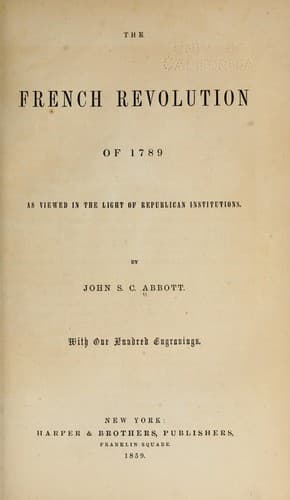
The French Revolution of 1789, as Viewed in the Light of Republican InstitutionsAbbott, John S. C. (John Stevens Cabot)
History
The French Revolution of 1789, as Viewed in the Light of Republican Institutions
Abbott, John S. C. (John Stevens Cabot)
France -- History -- Revolution, 1789-1799
It was not the intention of the king immediately to leave France.
He arranged to go to Montmedy, about two hundred miles from Paris,
taking the very retired Chalons road through Clermont and Varennes.
The Marquis of Bouillé, a general entirely devoted to the court party,
formed a camp at Montmedy to receive the king, under the pretense of
watching hostile movements on the frontiers. Small detachments of
cavalry were also very quietly posted at different points on the road
to aid in the flight. All the arrangements were made for starting on
the 20th of June.[272]
The king, though on the whole a worthy man, and possessing some
excellent traits of character, was in some points weak almost to
imbecility. All the energy of the family was with the queen, and she,
with the Marquis of Bouillé, planned the escape. They were often
thwarted, however, in their wishes by the obstinacy of the king. La
Fayette was entirely deceived, and but few even of the court were
intrusted with the secret. Still, rumors of flight had been repeatedly
circulated, and the people were in a state of constant anxiety lest
the court should carry off the king. They hardly believed that the
king himself wished to join the emigrants, and to urge war against the
Constitution which he had sworn to accept.
The Swiss Guards still surrounded the Tuileries. They were stationed,
however, only at the exterior posts. The interior of the palace, the
staircases, and the communications between the rooms were occupied by
the National Guard, in whom the nation could place more reliance. It
was a long-established custom that troops should be thus stationed
throughout the palace, that the royal family might be protected from
impertinence or from any irruption of popular violence. Since the
terrible scenes of the 5th and 6th of October it became more important
than ever that a strong guard should encircle the royal family. But
while the ostensible duty of this guard was only to protect the king
from insult, it had also a secret mission to prevent the king's escape.
FOOTNOTES:
[Footnote 258: "I have read many histories of revolutions, and can
affirm what a Royalist avowed in 1791, that never had any great
revolution cost less bloodshed and weeping. In reality, only one
class, the clergy, was able, with any appearance of truth, to call
itself robbed; and, nevertheless, the result of that spoliation was,
that the great bulk of the clergy, starved under the old system
for the emolument of a few prelates, had at length a comfortable
livelihood."--_Michelet_, p. 417.]
[Footnote 259: "If I had never lived with Mirabeau," says Dumont, "I
should never have known what a man can make of one day--what things may
be placed within the interval of twelve hours. A day for this man is
more than a week or a month is for others. The mass of things he guided
on together was prodigious; from the scheming to the executing, not a
moment lost."--_Dumont_, p. 311.]
[Footnote 260: Michelet, p. 333.]
Public-domain text, read in full here on John Shaqi.
Reviews
Reviews
No reviews yet
Be the first to share your thoughts on this work.
Elsewhere in the archive
Join the Discussion
Join the discussion
Sign in to leave a comment or review.
Sign InorCreate an account