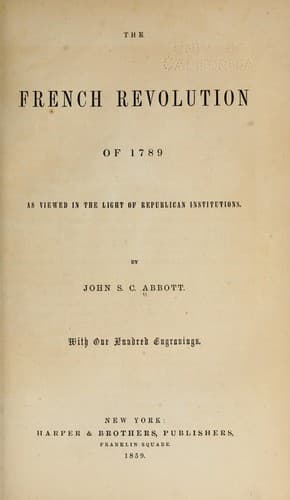
The French Revolution of 1789, as Viewed in the Light of Republican Institutions — John Shaqi
The French Revolution of 1789, as Viewed in the Light of Republican InstitutionsAbbott, John S. C. (John Stevens Cabot)
History
The French Revolution of 1789, as Viewed in the Light of Republican Institutions
Abbott, John S. C. (John Stevens Cabot)
France -- History -- Revolution, 1789-1799
The house of Valois retained the throne for two hundred and sixty-one
years. During these two and a half centuries, as generations came and
went, storms of war and woe were incessantly sweeping over France.
The history of the kingdom during these dreary ages is but the record
of the intrigues of ecclesiastics, the conflicts between monarchs and
nobles, and the sweep of maddened armies. The _Third Estate_, the
people, continued to be deprived of almost all social and political
rights. They were debased by ignorance and depressed by intolerable
burdens. The monarchy was gradually centralizing power. The chiefs
and sub-chiefs of the conglomerated tribes were losing their feudal
authority and lapsing into nobles of higher and lower rank, whose
splendor was obtained by exemption from all the burdens of the state,
and by enormous taxation of the people. The Roman Catholic Church,
under the Popes, blazed with almost supernatural splendor over Europe;
and the high dignitaries of the Church, as lords spiritual, were as
luxurious, haughty, and domineering as were any of the lords temporal.
Henry III., the last of the Valois race, was stabbed by a friar in
1589, and died leaving no issue. Henry of Bourbon, King of Navarre,
as the nearest relative, claimed the crown. He ascended the throne
as Henry IV., and after several years of civil war put down all
opposition. He was the first of the Bourbon family who swayed the
sceptre, and by far the most able and energetic. Under his vigorous
sway the kingdom became consolidated, the throne attained a great
supremacy over the nobles, and the resources of the realm were greatly
developed. Henry IV. was sincerely devoted to the interests of France.
He encouraged commerce, manufactures, and the arts; endeavored to
enforce equitable laws, and under his wise administration the _people_
made decided advances in wealth and intelligence. He retained the
throne for twenty-one years, until 1610, when he died beneath the
dagger of an assassin. Though Henry governed _for_ the people, he did
not admit them to any voice in public affairs. During his long reign no
assembly was convened in which the people had any representation.
Public-domain text, read in full here on John Shaqi.
Reviews
Reviews
No reviews yet
Be the first to share your thoughts on this work.
Join the Discussion
Join the discussion
Sign in to leave a comment or review.
Sign InorCreate an account