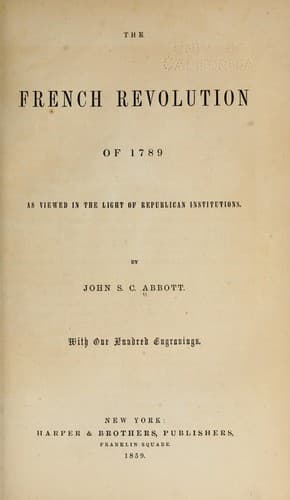
The French Revolution of 1789, as Viewed in the Light of Republican InstitutionsAbbott, John S. C. (John Stevens Cabot)
History
The French Revolution of 1789, as Viewed in the Light of Republican Institutions
Abbott, John S. C. (John Stevens Cabot)
France -- History -- Revolution, 1789-1799
This was true. The hussars were Germans. Blindly obeying their
officers, they had no idea of the commission upon which they had been
sent. They were now surrounded by the populace, and were listening,
with surprise and sympathy, to their narrative of the events. At
this critical moment the municipality of Varennes, accompanied by
the officers of the National Guard in that place, entered the shop.
Accustomed as they had long been to revere and almost to adore royalty,
for the rural districts had by no means kept pace with Paris in
disregard of the throne, the officers threw themselves upon their knees
before the king and said,
"In God's name, sire, do not forsake us; do not quit the kingdom."
"It is not my intention," the king replied, "to leave France. The
insults I have suffered force me to leave Paris. I am going only to
Montmedy, and I invite you to accompany me thither; only give orders, I
pray you, for my carriages to be got ready."
The municipal authorities departed to deliberate, begging the king to
wait till the light should dawn. It was now two o'clock in the morning.
The chances of escape were every moment diminishing. The crowd, armed
with such weapons as they could on the moment seize, had become
formidable; the bridge was so barricaded that it could not be passed;
and but little reliance could be placed in the fidelity of the hussars.
There was, however, a ford near by, where the stream could be passed
on horseback. Choiseul and Goguelat entreated the king and queen, with
the ladies, immediately to mount on horseback, the king holding the
dauphin on the saddle, and, protected by the forty hussars, to cross
the stream, and attempt to effect their escape.
The queen, whose personal heroism never forsook her, looked at her
children, thought of the bullets which might be showered upon them,
and, yielding to a mother's love, hesitated. The king also, who never
dishonored himself by an act of cowardice, thought only of the peril of
those who were dearer to him than life, and said,
"But can you assure me that in this struggle a shot may not strike the
queen, my sister, or the children? Besides, the municipality does not
forbid to let us pass; it merely requests me to wait till daybreak.
Moreover, the Marquis de Bouillé is at Stenay, but twenty-four miles
distant. He can not fail to learn of my detention, and he will be here
with his troops in the morning."
Another weary hour of agitation, tumult, and gathering excitement
passed away, and the clock struck three. The hussars were now
completely gained over by the people, and were drinking with them "To
the Nation."
The municipal authorities, having briefly deliberated, returned to the
king with this short but terrible announcement,
"The people, being absolutely opposed to the king continuing his
journey, have resolved to dispatch a courier to the National Assembly
in order to be informed of its intentions."
Public-domain text, read in full here on John Shaqi.
Reviews
Reviews
No reviews yet
Be the first to share your thoughts on this work.
Elsewhere in the archive
Join the Discussion
Join the discussion
Sign in to leave a comment or review.
Sign InorCreate an account