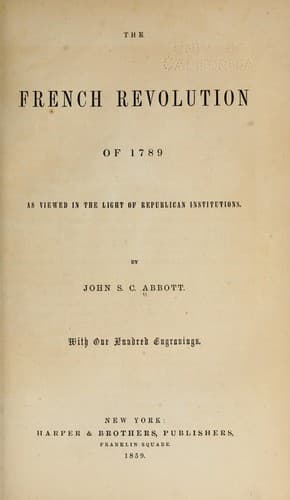
The French Revolution of 1789, as Viewed in the Light of Republican InstitutionsAbbott, John S. C. (John Stevens Cabot)
History
The French Revolution of 1789, as Viewed in the Light of Republican Institutions
Abbott, John S. C. (John Stevens Cabot)
France -- History -- Revolution, 1789-1799
M. de Goguelat now went out into the surging crowd to judge if it were
possible to fight their way through. Mounting his horse he rode slowly
around, when Drouet approached him and said, "You want to carry off the
king, but you shall not have him alive."
The carriage was surrounded by a body of the National Guard. Goguelat
approached the carriage with a few hussars who still hesitatingly
obeyed his orders, when the major in command of the detachment of the
National Guard said to him, "One step farther, and I shoot you."
Goguelat spurred his horse on, when a pistol was discharged. Two
bullets struck him, and he fell bleeding to the ground. He was,
however, able to rise and enter the shop, but the hussars immediately
with acclaim avowed themselves the soldiers of the nation. Goguelat
had observed also that at the end of the street there were two cannons
planted which seemed ready to fire upon them. There was no longer the
possibility of escape by force, unless M. de Bouillé should chance to
arrive in season with his well-trained dragoons.
As Goguelat, wounded and covered with blood, again entered the presence
of the royal family, they presented a heart-rending spectacle. The
queen was sitting upon a bench between two boxes of candles, piteously
pleading with the grocer's wife to intercede with her husband in their
behalf.
"You are a mother, madame," said the queen; "you are a wife; the fate
of a wife and mother is in your hands. Think what I must suffer for
these children, for my husband. At one word from you I shall owe them
to you. The Queen of France will owe you more than her kingdom, more
than life."
There is an instinct, unreflecting, in the human heart, which says that
it would have been _noble_ in the woman to have periled every thing
to save the queen. The universal heart does homage to disinterested
benevolence, even when it is unthinking and mistaken. But in this case
the good woman, with very natural and prosaic common sense, said,
"I wish it were in my power to help you. But bless me! you are thinking
of your husband and I am thinking of mine. Every woman for her own
husband."
This speech certainly did not indicate a heroic nature. But it is
obvious that M. Sausse had now no power to save the king. Matters had
proceeded far beyond his control. If he could by any stratagem have
facilitated the flight, his own life would have been the inevitable
forfeit. It would have been treason to the nation. Humanity also seemed
imperiously to demand that the king should be stopped. His escape would
place him at the head of foreign and hostile armies to ravage France
with the horrors of war, and to quench the kindling flame of liberty in
blood.
Public-domain text, read in full here on John Shaqi.
Reviews
Reviews
No reviews yet
Be the first to share your thoughts on this work.
Elsewhere in the archive
Join the Discussion
Join the discussion
Sign in to leave a comment or review.
Sign InorCreate an account