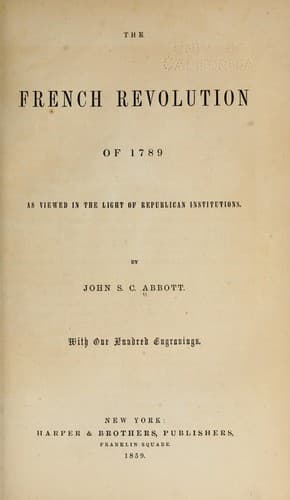
The French Revolution of 1789, as Viewed in the Light of Republican InstitutionsAbbott, John S. C. (John Stevens Cabot)
History
The French Revolution of 1789, as Viewed in the Light of Republican Institutions
Abbott, John S. C. (John Stevens Cabot)
France -- History -- Revolution, 1789-1799
Just then the door opened, and M. de Romeuf entered. He was an
aide-de-camp of the Marquis de la Fayette and a true patriot, while at
the same time he was well known by the royal family as a friend of the
king. He entered, holding the decree in his hand, greatly agitated;
and, as he beheld the humiliating condition of the sovereign of France,
and was conscious of the most painful duty devolving upon himself, he
could not restrain his emotions, but bowed his head and wept bitterly.
There is not a generous heart on earth which will not be in sympathy
with that grief.
As the queen raised her eyes and saw M. de Romeuf enter, she exclaimed,
with surprise and indignation,
"What, sir, is it you? Oh! I could never have believed it possible."
Romeuf replied sadly, "We have done only our duty; but we hoped not to
have overtaken your majesties."[276]
The king took from the hand of Romeuf the decree of the Assembly
and hastily read it. It was an order enjoining upon all public
functionaries "to stop, by all the means in their power, _the abduction
of the king_, and to prevent the continuance of the journey."
The king indignantly threw the decree upon the bed where the children
were sleeping, and exclaimed, in words whose truth he then by no means
fully realized,
"_There is no longer any King in France_."
The queen, with pardonable but very injudicious passion, picked up the
decree of the National Assembly and threw it upon the floor, saying
vehemently,
"It shall not defile my children."
"Madame," said Romeuf sorrowfully to the queen, to whom he was much
attached, "in the name of your safety, your glory, I entreat you to
control your grief. Would you rather have any one but me witness these
passions?"
The gentle reproach recalled the queen to herself, and she nerved
herself to endurance, calmness, and dignity. The mental agony of
that dreadful night had already turned her hair from auburn into the
whiteness of snow.
It was greatly feared that the troops of Bouillé might come and rescue
the king. Preparations for the departure were therefore hastened.
Six horses were harnessed into the carriage, and the royal family,
notwithstanding they did every thing in their power to cause delay,
were forced to take their seats. The queen would not allow any one to
touch her son, but carried him in her own arms to the carriage.
The melancholy cortège now commenced its slow progress toward Paris,
escorted by four thousand of the National Guard.
Public-domain text, read in full here on John Shaqi.
Reviews
Reviews
No reviews yet
Be the first to share your thoughts on this work.
Elsewhere in the archive
Join the Discussion
Join the discussion
Sign in to leave a comment or review.
Sign InorCreate an account