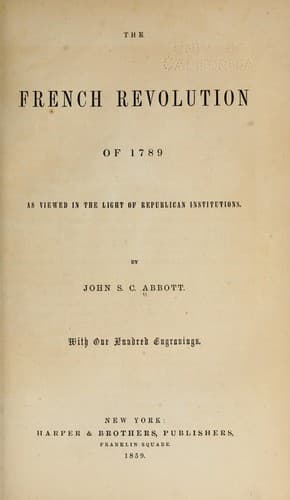
The French Revolution of 1789, as Viewed in the Light of Republican InstitutionsAbbott, John S. C. (John Stevens Cabot)
History
The French Revolution of 1789, as Viewed in the Light of Republican Institutions
Abbott, John S. C. (John Stevens Cabot)
France -- History -- Revolution, 1789-1799
The queen, whose energetic mind foresaw the awful future, was
overwhelmed and burst into tears. The king had now lost all
self-possession, and was bewildered as a child. The people, who began
to be apprehensive that the troops of Bouillé might come to the
rescue, were crowding the door and shouting, "Back, back to Paris."
The king was urged to show himself, that he might tranquilize the
people. He went to a window and looked out upon the excited multitude,
over whom a few torches shed a lurid light. The sight of the king at
first produced profound silence. The people then, as versatile as
children, were so affected by the appearance of the king in his servile
dress, and with his woe-worn countenance, that many wept; and while not
one word of insult was heard, many cried out, in compassionate tones,
_Vive le Roi_!
The day was then just beginning to dawn. Gradually the sun rose, and
shone upon a strange spectacle. The guns, the drums, the alarm-bells
had roused the whole country around. Ten thousand men had already
assembled in Varennes, choking the narrow street where the grocery
stood. From all directions the country people were seen hurrying to the
town, as the strange tidings of the attempted flight and arrest were
spreading far and wide. As the crowd increased in the streets, and the
gloom of night was dispelled by the bright blaze of day, the tumult
rose higher and higher. All sympathy for the royal family seemed to
give place to a feeling of indignation, that they should be stealing
away to lead foreign armies to make war upon the liberties of France.
At seven o'clock the door opened, and the king beheld, to his surprise,
an officer of the National Guard of Paris. His dress was disordered,
and he was dusty and worn with hurried travel. The man was greatly
agitated when he found himself in the presence of the king, and could
only stammer, in broken and almost incoherent phrase, the words,
"Sire, all Paris is being murdered; our wives and children are perhaps
assassinated; you shall not go any farther; sire, the interests of the
state; yes, sire, our wives and our children."
The queen seized the hand of the officer, and, leading him to a humble
bed in the corner, where the two royal children, Maria and Louis,
utterly exhausted, were sleeping, said to him, as she pointed to the
children,
"Am I not a mother also?"[275]
The king, interrupting her, turned abruptly to the officer, and said,
"What do you want?"
"Sire," he replied, "I have a decree of the Assembly."
"Where is it?" inquired the king.
"My comrade has it," was the reply.
Public-domain text, read in full here on John Shaqi.
Reviews
Reviews
No reviews yet
Be the first to share your thoughts on this work.
Elsewhere in the archive
Join the Discussion
Join the discussion
Sign in to leave a comment or review.
Sign InorCreate an account