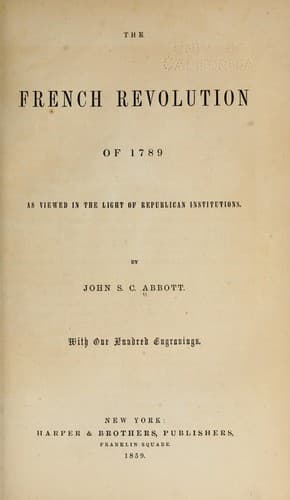
The French Revolution of 1789, as Viewed in the Light of Republican InstitutionsAbbott, John S. C. (John Stevens Cabot)
History
The French Revolution of 1789, as Viewed in the Light of Republican Institutions
Abbott, John S. C. (John Stevens Cabot)
France -- History -- Revolution, 1789-1799
"It was my wish," said the king, "to increase the force of the
executive power. I did not think that this constitutional act could
be maintained without more power being placed in the hands of the
sovereign, since France does not wish to be a republic."
"Not yet, to be sure," Pétion brutally replied; "the French are not yet
quite ripe enough for a republic."
No more conversation was held with Pétion. The movement of the
carriages, encumbered by the escort and the immense crowds who thronged
the way, was very slow. Four days were occupied in the return. It was
seven o'clock in the evening of the 25th when the long procession
entered Paris. As the carriages approached the suburbs the crowd
increased in density. It had been a day of intense heat. The blaze
of the sun, reflected by the pavements and by the bayonets which
surrounded the carriage, was almost intolerable. The carriages were
continually enveloped in a dense cloud of dust. The inmates panted for
breath and were bathed in perspiration. One of the children suffered so
much that the queen, alarmed, appealed to the compassion of the crowd.
"See, gentlemen," she said, letting down one of the windows, "in what a
state my poor children are; one is choking."
A brutal wretch exclaimed, in an under tone, "We will soon choke you,
after another fashion."
Generally the crowd looked on in amazement and silence. Feelings of
pity and humanity triumphed over indignation. Great eagerness was
of course manifested to catch a sight of the king and queen, but
well-armed guards on horseback surrounded the carriages. La Fayette
came out of the city to meet the cortège at a few miles distance and
to assume the command. Apprehensive of violence from the infuriate
populace of Paris, if the immense cortège, now numbering nearly three
hundred thousand and rapidly increasing, were to pass through the
narrow streets of the city, the carriages were ordered to take a
circuit and enter by the broad avenue of the Elysian Fields, which
conducted directly to the Tuileries. As an additional precaution he
placed troops in a deep line on both sides of the avenue from the
Barrier de l'Etoile to the palace.
It was resolved that the king should be received in silence, without
applause and without abuse. Placards were posted every where with the
laconic announcement,
"Whoever applauds the king shall be flogged; whoever insults him shall
be hanged."[282]
The procession now entered the city amid the clashing of sabres, the
trampling of horses, and the confused, suppressed murmurs of half
a million of men. It was another sublime act in that most terrible
tragedy of time. It can not be described; it can not be fully
conceived; it has never been paralleled.
Public-domain text, read in full here on John Shaqi.
Reviews
Reviews
No reviews yet
Be the first to share your thoughts on this work.
Elsewhere in the archive
Join the Discussion
Join the discussion
Sign in to leave a comment or review.
Sign InorCreate an account