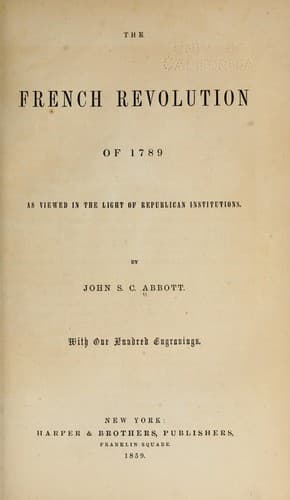
The French Revolution of 1789, as Viewed in the Light of Republican InstitutionsAbbott, John S. C. (John Stevens Cabot)
History
The French Revolution of 1789, as Viewed in the Light of Republican Institutions
Abbott, John S. C. (John Stevens Cabot)
France -- History -- Revolution, 1789-1799
The crowd-encompassed, dust-enveloped carriages entered the city at the
close of one of the most lovely of June afternoons. The cloudless sun,
still an hour above the horizon, shone brilliantly upon the spectacle,
gilding steeples and domes as with rejoicing light. The whole military
array of Paris, horsemen, artillery, and infantry, lined that majestic
avenue. Behind them the whole population of Paris seemed to flood the
field, filling windows, balconies, house-tops, steeples, trees, and
every point of observation.
La Fayette and his staff first made their appearance as the vast
procession commenced its entrance. A numerous cavalcade of mounted
guards then succeeded. These were followed by the two royal carriages,
each drawn by six horses, and surrounded by dragoons whose sabres
gleamed in the rays of the setting sun. Several regiments of artillery
and infantry, in compact order, ensued, and then came a motley mass of
three hundred thousand stragglers, men, women, and children, whom the
strange event had gathered from all the suburbs of the metropolis.
Almost perfect silence reigned. It was like a procession of the shades
of the departed in the spirit land. There was no ringing of bells, no
explosion of cannon, no plaudits of the multitude, no bursts of martial
bands in requiems or jubilata. The king, humiliated, sunk back in his
carriage, and concealed himself as far as possible from observation.
The bayonets of the soldiers held in check the ferocious and brutal
wretches who would gladly have assailed the monarch with execrations.
The same power closed the lips of the Royalists, who would have greeted
their sovereign with applause.
Thousands gazed upon the scene in silent sympathy, with their eyes
bathed in tears. They loved the cause of constitutional liberty; they
wept over the infatuation and folly of the king. The reception was
sublime in its appropriateness. No honors were conferred upon the king,
for surely he deserved none. No abuse assailed him, for that would but
have degraded those who offered it.
[Illustration: RETURN OF THE ROYAL FAMILY FROM VARENNES.]
Public-domain text, read in full here on John Shaqi.
Reviews
Reviews
No reviews yet
Be the first to share your thoughts on this work.
Elsewhere in the archive
Join the Discussion
Join the discussion
Sign in to leave a comment or review.
Sign InorCreate an account