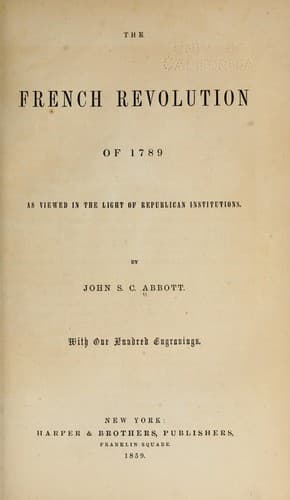
The French Revolution of 1789, as Viewed in the Light of Republican InstitutionsAbbott, John S. C. (John Stevens Cabot)
History
The French Revolution of 1789, as Viewed in the Light of Republican Institutions
Abbott, John S. C. (John Stevens Cabot)
France -- History -- Revolution, 1789-1799
The crowd grew more and more dense as the carriages entered the garden
of the Tuileries, and the way became so obstructed by the throng that
it was with no little difficulty that a passage was secured. As soon as
the carriages arrived at the door of the palace, near the end of the
terrace, the royal family alighted and passed through a double file
of the National Guard drawn up for their protection. In this hour of
misfortune, those who had been most hostile to the despotism of the
court vied with each other in their endeavors to protect fallen royalty
from indignities. The Viscount of Noailles, a warm friend of reform,
and a humane, magnanimous man, approached the queen, who was the
last to alight from the carriage, and offered her his arm to conduct
her into the palace. The queen, with imprudent but perhaps pardonable
pride, haughtily rejected the aid of the friend of the people, and,
seeing one of the partisans of the court near by, asked his arm.
The hall of the Assembly, since destroyed, looked out upon the garden
of the Tuileries. The excitement of the hour suspended the sitting, but
it was immediately resumed when the king had safely entered the palace.
The king seemed perfectly calm. La Fayette, with profound respect and
with his sympathies most deeply moved, presented himself at the king's
apartment, and, making no allusion to the unprecedented scene which had
transpired, said, "Has your majesty any orders to give me?"
"It appears to me," replied the king with a smile, "that I am much more
under your orders than you are under mine." The conduct of the queen
in this trying hour was peculiarly unfortunate. The royal family then
needed every friend it could win. But the queen, losing the control of
her passions, seemed to bid defiance to all who were not the partisans
of the court, and endeavored to gratify her resentment in goading those
she deemed her foes by those taunts of action which are even more
exasperating than words.
Assuming that La Fayette was her jailer, she approached that noble
patriot, who was willing to shed the last drop of his blood to save her
from indignities, and handed him the keys of her trunks. La Fayette,
wounded by conduct so ungenerous, and commiserating the condition of
the queen, bowed, refusing to receive them, and, in tones saddened by
pity and sorrow, declared that no one would think of interfering with
her private property.
The unhappy queen so far forgot herself as peevishly to throw the keys
into La Fayette's hat, which was upon the table. This was the conduct
of a spoiled child. Such was Marie Antoinette. It was this spirit which
accelerated her passage to the scaffold. The compassion of La Fayette
triumphed over resentment. Overlooking the insult, he calmly replied,
"Madam, you must pardon me the trouble I give you in returning these
keys. I certainly can not touch them."
"Well, then," replied the queen, pettishly, "I shall find other persons
less scrupulous than you are."[283]
Public-domain text, read in full here on John Shaqi.
Reviews
Reviews
No reviews yet
Be the first to share your thoughts on this work.
Elsewhere in the archive
Join the Discussion
Join the discussion
Sign in to leave a comment or review.
Sign InorCreate an account