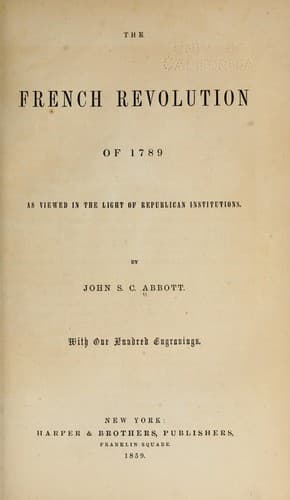
The French Revolution of 1789, as Viewed in the Light of Republican InstitutionsAbbott, John S. C. (John Stevens Cabot)
History
The French Revolution of 1789, as Viewed in the Light of Republican Institutions
Abbott, John S. C. (John Stevens Cabot)
France -- History -- Revolution, 1789-1799
"Those who have lost ought to perceive that it is impossible to make
the Revolution retrograde. Those who fashioned the Revolution should
see that it has attained its consummation. Kings themselves--if from
time to time profound truths can penetrate the councils of kings,
if occasionally the prejudices which surround them will permit the
sound views of a great and philosophical policy to reach them--kings
themselves must learn that there is for them a wide difference between
the example of a great reform in government and that of the abolition
of royalty; that if we pause here, where we are, they are still kings!
But, be their conduct what it may, let the fault come from them and not
from us. Regenerators of the empire, follow straightly your undeviating
line. You have been courageous and potent--be to-day wise and moderate.
In this will consist the glorious termination of your efforts. Then
again returning to your domestic hearths you will obtain, if not
blessings, at least the silence of calumny."
Though these views of moderation were opposed alike by the aristocrats
and the Jacobins, they were accepted with applause by the great
majority of the Assembly. Aristocrats and Jacobins now combined to
disturb in every possible way the action of the Assembly. They both
hoped through tumult and anarchy to march into power. Mobs began to
reassemble in the streets of Paris, and cries of treason were uttered
against La Fayette and his fellow-constitutionalists. Already in the
market-place, at the Palais Royal, and in the hall of the Jacobins,
individuals denounced that Constitution as tyrannical which the nation
had so recently, with unutterable enthusiasm, sworn to support.[289]
La Fayette, Barnave, the Lameths, Talleyrand, and other illustrious
friends of a constitutional monarchy, sent a confidential note to the
Emperor of Austria, assuring him that the Constitution conferred as
much power upon the king as it was possible now to obtain from the
French nation; that any invasion of France by the allies would only
exasperate the people, bring the Jacobins into power, endanger the
life of the king, and that it could not be successful in restoring the
Old Régime. The king was consulted upon this measure, and gave it his
approval.[290]
Notwithstanding these warnings, the monarchs of Europe, who were
trembling lest the spirit of liberty, rising in France, should
undermine their despotic thrones, resolved to crush the patriots
beneath the tramp of their dragoons. Leopold of Austria, Frederick
William of Prussia, and Count d'Artois, with Bouillé and other of
the emigrants, met at Pilnitz, and on the 27th of August signed
an agreement that the French Revolution was an "open revolt," "a
scandalous usurpation of power," and that all the governments of Europe
were bound to unite to abate the nuisance.[291]
Public-domain text, read in full here on John Shaqi.
Reviews
Reviews
No reviews yet
Be the first to share your thoughts on this work.
Elsewhere in the archive
Join the Discussion
Join the discussion
Sign in to leave a comment or review.
Sign InorCreate an account