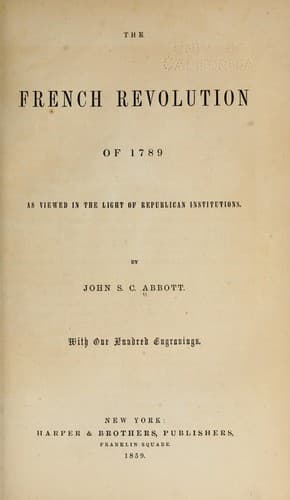
The French Revolution of 1789, as Viewed in the Light of Republican InstitutionsAbbott, John S. C. (John Stevens Cabot)
History
The French Revolution of 1789, as Viewed in the Light of Republican Institutions
Abbott, John S. C. (John Stevens Cabot)
France -- History -- Revolution, 1789-1799
"But if it be true that in our territory there is a vast population;
that we have a multitude of men exclusively devoted to those
intellectual speculations which excite ambition and the love of fame;
that powerful neighbors compel us to form one compact body in order
to resist them--if these circumstances are wholly independent of
ourselves, then it is undeniable that the sole existing remedy lies in
a monarchical government.
"When a country is populous and extensive, there are but two modes
of assuring to it a solid and permanent existence. Either you must
organize those parts separately, placing in each section of the empire
a portion of the government, thus maintaining security at the expense
of unity, strength, and all the advantages which result from a great
and homogeneous association, or else you will be forced to centralize
an unchangeable power, which, never renewed by the law, presenting
incessant obstacles to ambition, resists with advantage the shocks,
rivalries, and rapid vibrations of an immense population, agitated by
all the passions engendered by long-established society.
"These facts decide our position. We can only be strong through a
_federative government_, which no one here has the madness to propose,
or by a _monarchical government_ such as you have established. You have
intrusted to an _inviolable_ king the exclusive function of naming the
agents of his power, but you have made those agents responsible.
"Immense damage is done us when that revolutionary impetus, which has
destroyed every thing there was to destroy, and which has urged us to
the point where we must at last pause, is perpetuated. The Revolution
can not advance one step farther without danger. In the line of
_liberty_ the first act which follows is the annihilation of royalty.
In the line of _equality_ the first act which must follow is an attempt
on all property. It is time to end the Revolution. It ought to stop
when the nation is free, and all men have equal rights. If it continue
in trouble it is dishonored, and we with it. Yes! all the world ought
to agree that the common interest is involved in now closing the
Revolution.
Public-domain text, read in full here on John Shaqi.
Reviews
Reviews
No reviews yet
Be the first to share your thoughts on this work.
Elsewhere in the archive
Join the Discussion
Join the discussion
Sign in to leave a comment or review.
Sign InorCreate an account