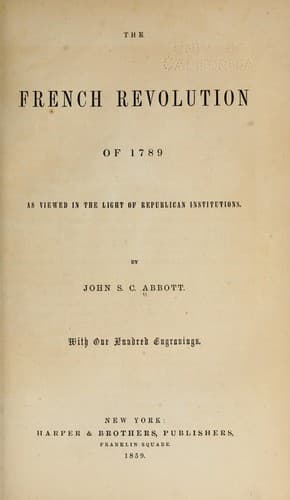
The French Revolution of 1789, as Viewed in the Light of Republican InstitutionsAbbott, John S. C. (John Stevens Cabot)
History
The French Revolution of 1789, as Viewed in the Light of Republican Institutions
Abbott, John S. C. (John Stevens Cabot)
France -- History -- Revolution, 1789-1799
"I demand," exclaimed another, "that this title of _Sire_ be abolished.
It is only an abbreviation of Seigneur, which recognizes a sovereignty
in the man to whom it is given. There is no other majesty here than
that of the law and the people. Let us leave the king no other title
than that of King of the French."
In the room there was a gilded chair, raised above the seat of the
president, which was occupied by the king when he attended the
Assembly. It had always been a respectful custom for the members to
remain uncovered when the king was present, and to stand while he
addressed them. It was the custom for the king, in addressing the
Assembly, to be seated and to wear his hat.
"Let this scandalous gilded chair be removed," another said. "Let an
equality exist between us and the king as regards ceremony. When he is
uncovered and standing, let us stand and uncover our heads. When he is
covered and seated, let us sit and wear our hats."
These decrees, abolishing the respect due to rank, and the courtesies
so essential to mitigate the ferocity of political strife, were
promptly passed. The Constitutional party throughout France were
generally mortified and alarmed, and the king was deeply wounded. He
declared that the Constitution did not require of him to expose the
monarchical dignity to insult, and that he would not preside at the
opening of the legislative body in person, but would assign the duty
to his ministers.[303] Alarmed by the decision of the king and by the
indications of public disapproval, the Assembly, after a debate of two
days, repealed the obnoxious decrees.
The Jacobins regarded the repeal as a defeat, and in the Assembly,
in their clubs, and in their journals, did what they could to rouse
the indignation of the populace. The royalist journals also united
with them in the attempt to overwhelm this return to moderation with
derision. "See," they cried, "how contemptible is this revolution; how
conscious of its own weakness. See, in two days, how often it has given
itself the lie." The Royalists still persisted in their endeavor to
goad the revolutionary party to every conceivable outrage, that Europe
might be more effectually roused to crush the Revolution.[304]
On the 7th the king proceeded to the Assembly. He was received,
apparently, with unanimous applause, some shouting energetically "_Vive
le Roi!_" and others, still more energetically, "_Vive sa majesté!_"
The king's speech was conciliatory, and was received with warm
approval. The members of the Assembly, however, retained their seats
while the king was addressing them. Louis regarded this as an insult,
and it wounded him most keenly.
Public-domain text, read in full here on John Shaqi.
Reviews
Reviews
No reviews yet
Be the first to share your thoughts on this work.
Elsewhere in the archive
Join the Discussion
Join the discussion
Sign in to leave a comment or review.
Sign InorCreate an account